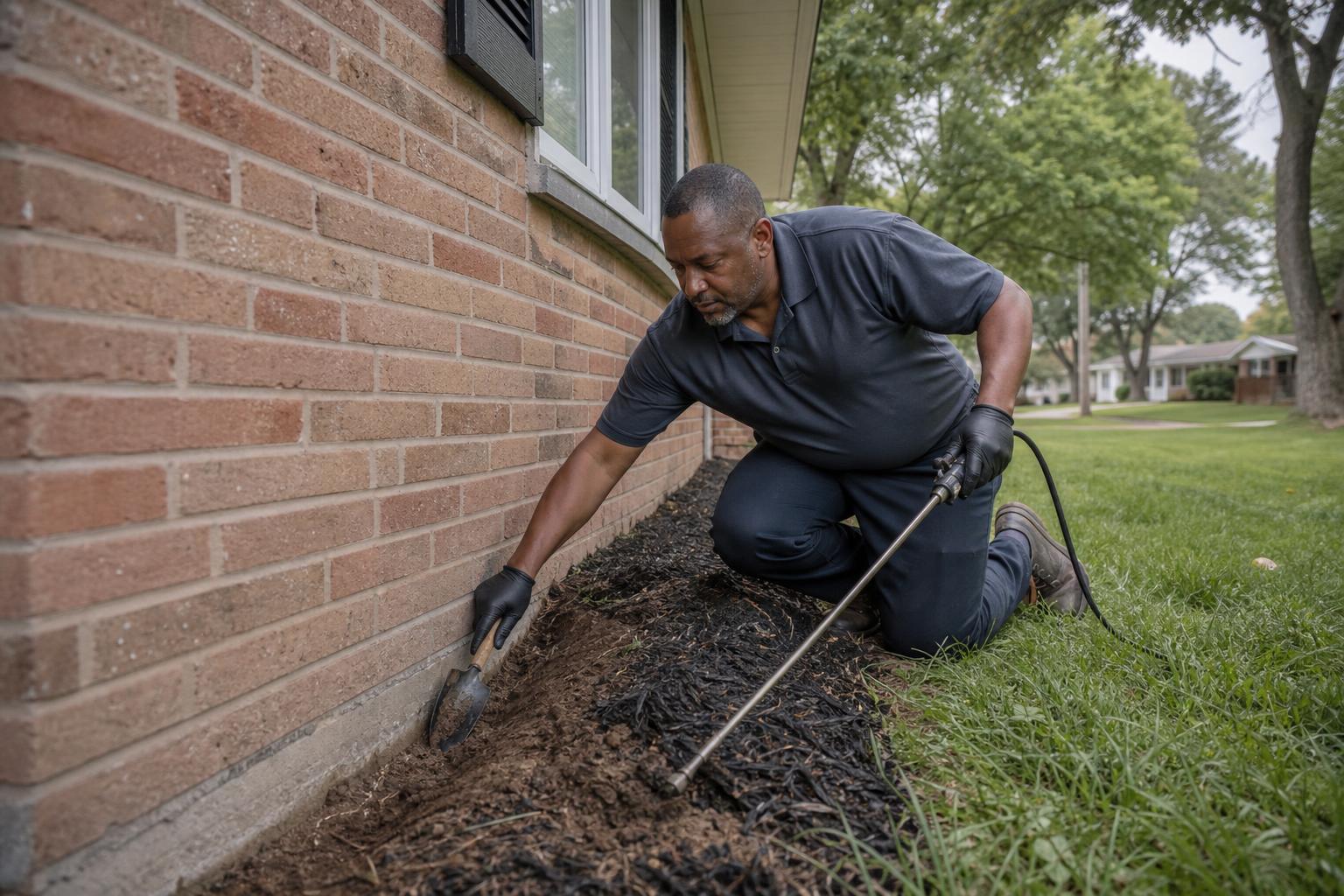
This page is about the day itself. Once Richard has inspected your home and shown you the evidence, termite treatment in Evansville comes down to one of two approaches: a liquid termiticide barrier in the soil around the foundation, or a bait station system around the perimeter. Here is how we choose, what the crew does at your house, and what you will see afterward.
- Decided byRichard, owner, Indiana 7B termite license
- MethodsLiquid barrier, bait stations, or both
- Typical jobHalf a day to a day; you can usually stay home
- AfterwardWritten summary and a follow-up schedule
How we choose between a liquid barrier and bait stations
Both work against the eastern subterranean termite, the one across Southwest Indiana. Neither is right for every house. The decision gets made at the inspection, on your property, based on four things.
- Construction type. Brick veneer, poured walls, an attached porch or garage slab: each changes where the soil can be reached and where drilling is needed.
- Slab or crawlspace. A crawlspace lets us treat piers and the inside of the wall from below. On a slab, the colony often comes up through a bath trap or expansion joint, which can mean drilling the floor there.
- Wells and water. A private well, a cistern, a creek or a French drain along the footing all matter. The product label sets distances from water, and we follow it. Where a liquid cannot go, stations can.
- Active or preventive. Live termites in a sill plate, or a WDI finding on a closing date, need the structure protected now. A home with no activity can take the slower, quieter route.
The liquid termiticide barrier
We dig a narrow trench along the outside of the foundation and apply the termiticide to the trench and the soil below it with a rod. Where a porch, stoop, patio or garage slab sits against the house, we drill small holes through the concrete on a set spacing, inject beneath it, and plug the holes. In a crawlspace, piers and the inside of the wall get the same treatment.
The products we use are non-repellent. Termites do not sense them, so foragers pass through the treated soil, pick the product up and carry it back into the colony. The barrier protects the house right away and works on the colony that has been feeding on it.
The bait station system
Stations go into the ground around the perimeter at regular intervals, with extra ones near known activity or wood contact. Each holds a bait termites prefer over the wood in your house. Foragers feed and share it through the colony, which declines and dies off over weeks to months. We come back on a schedule to open the lids, check for feeding and replace bait.
No trenching, and in most cases no drilling. It is slower, which is why an active infestation usually gets liquid at the point of entry even when stations go in around the rest of the house.
Treatment day, step by step
You confirm the plan
After the inspection you have a written quote naming the method, the areas involved and the follow-up schedule. Nothing happens until you have read it and said yes.
You do a little prep
Pull stored items a couple of feet off foundation walls in the basement or garage, clear a path to the crawlspace hatch, and move planters or firewood off the foundation outside. Pets stay away from the work. That is usually all of it.
We do the work
Trenching and rodding along the foundation, drilling and injecting under slabs where the plan calls for it, or setting stations around the perimeter. A typical house takes half a day to a day. You can usually stay home.
We walk you through it
Before we leave, a technician shows you where the trench ran, which holes were drilled and plugged, and where stations sit. You get a written summary for your records, which matters if you sell the house.
We follow up
Liquid jobs get a re-inspection. Bait systems get scheduled station checks. If you see swarmers or a new tube between visits, you call and we come look.
What you will see afterward
Normal things that look alarming the first week
- Drill plugs. Small, evenly spaced plugs in the porch, garage or patio concrete where we injected under the slab. They are permanent and can be color-matched or covered by flooring later.
- Station lids. Caps flush with the soil every several feet around the house. Mow over them; do not pull them up. They are how we check the system.
- Swarmers, briefly. Reproductives already developed inside the wood can still come out for a short time after treatment, especially in spring. That is not a failed job. Vacuum them up and tell us; if it continues past the first few weeks, we come back and look.
Liquid barrier vs. bait stations at a glance
| Liquid barrier | Bait station system | |
|---|---|---|
| What happens on treatment day | Trenching and rodding along the foundation; drilling under attached slabs. | Stations set in the soil around the perimeter. |
| Time to control | Structure protected as soon as the soil is treated. | Weeks to months, depending on how quickly foragers find the stations. |
| Disruption | Half a day to a day of digging and, where needed, drilling. | An hour or two of setting stations. No drilling or trenching in most cases. |
| Monitoring | Scheduled re-inspection of the foundation and structure. | Scheduled station checks, with bait replaced as it is eaten. |
| Best for | Active infestations, slab entry points, WDI findings with a closing date. | Homes near wells or water, homes where drilling is not wanted, long-term protection. |
Who does the work
Richard holds the Indiana 7A and 7B licenses; the technicians who trench, drill and set stations are certified through the Office of the Indiana State Chemist and work under his license. Fully insured, founded 2020. One termite customer put it this way.
I highly recommend Canine-Detect Pest Control. Very professional and knowledgeable. Richard and his team treated our home for termites. From the first call to Richard until completion of treatment we received professional service in a timely manner. Their work ethic and knowledge is followed up with outstanding customer service. It’s good to see that excellent customer service still exists.
After treatment: making the house harder to get into
A treatment deals with the colony that is there. It does not change the conditions that invited it: mulch against the siding, a downspout dumping at the footing, a damp crawlspace, firewood on the foundation. At the walkthrough we point out what we saw, and our termite prevention page goes through the fixes, most of which you can do yourself.
Treatment starts with the owner looking at your house.
Richard inspects for free, shows you what he found, and you get a written quote with the method and follow-up schedule. No phone estimates, no pressure.
More on termites
Termite control in Evansville
The overview: how termites get in, the signs, and how we handle them.
Termite inspection and WDI reports
What Richard checks, and what a WDI report for a closing includes.
Termite prevention
Moisture, grading, mulch and wood contact: keeping a treated home from a second colony.
Termite treatment questions, answered plainly
Do I have to leave the house during a termite treatment?
Usually not. The product goes into the soil and under slabs, not into your living space. We tell you before the job if a basement or garage area needs to stay clear, and for how long. Keep pets away from the work until we are done.
Why do you have to drill my porch or garage floor?
Because the soil under an attached slab touches the foundation, and termites use that gap. The only way to treat it is through the concrete. Holes are small, spaced on a pattern, and plugged when we are done. If drilling is not an option for you, that is one reason we might recommend stations instead.
I have a well. Can you still do a liquid treatment?
Sometimes. The product label sets a required distance from wells, cisterns and surface water, and we do not treat inside it. Where the well is close, we use bait stations on that side of the house or the whole perimeter.
How long until the termites are gone?
With a liquid barrier the structure is protected as soon as the soil is treated, and the colony declines over the following weeks. With bait stations it takes weeks to months, depending on how fast foragers find them. We check on a schedule either way and tell you what we find.
I saw swarmers a week after treatment. Did it fail?
Probably not. The treatment works on the colony through feeding and contact, not on reproductives already sealed in the wood, so a few can still emerge for a short while. Vacuum them up and call us so we have it on record. If swarmers keep appearing past the first few weeks, or you see a new mud tube, we come back and look.