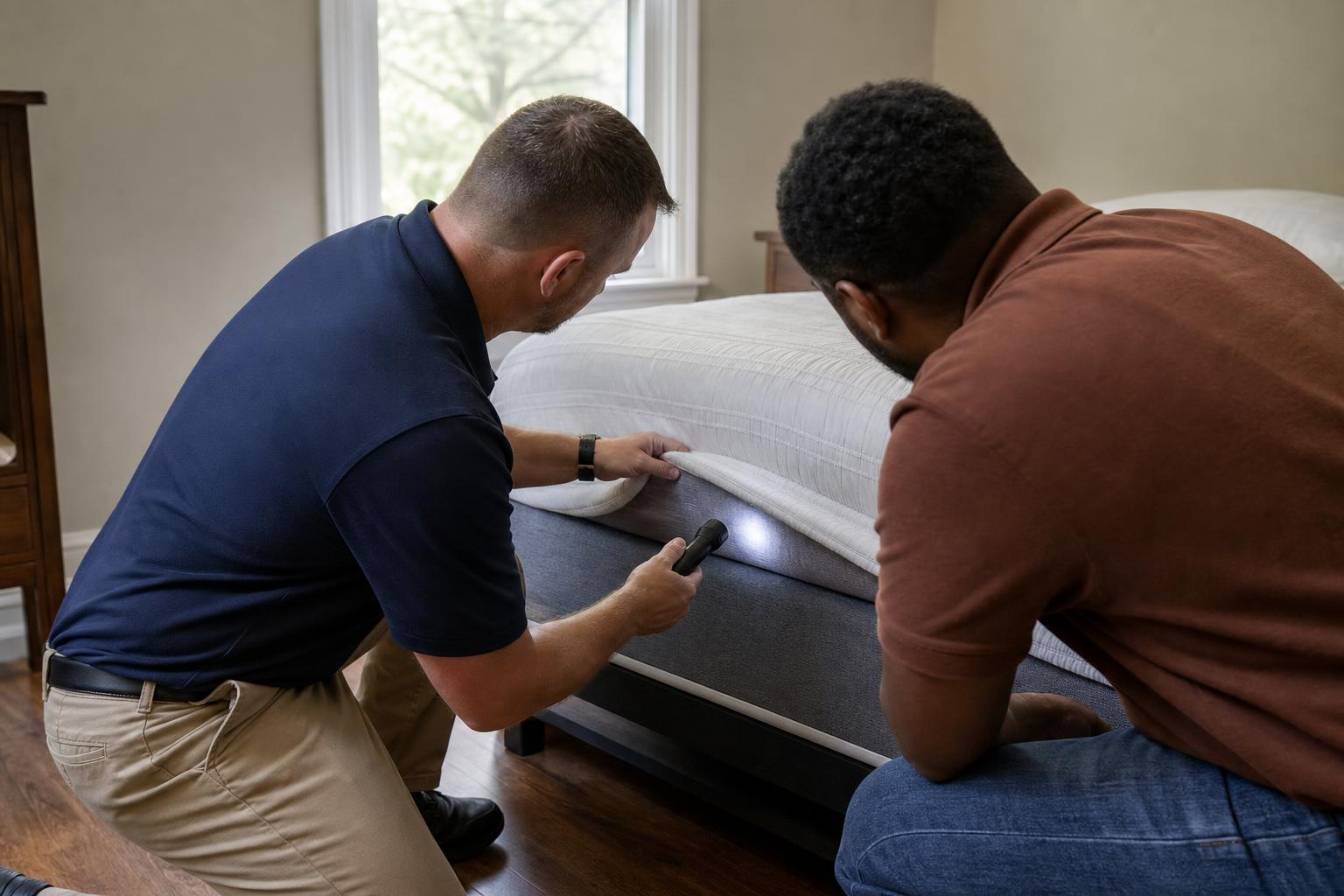
A first visit from us is an inspection, not a sales call. Nobody is coming to your house in Evansville to pitch you a plan. Richard, our owner, holds Indiana 7A (supervisory) and 7B (termite) licenses and does most first inspections himself; when he cannot, Gil, our operations manager, comes instead. Here is what happens at a pest inspection with Canine-Detect, from the knock on the door to the written plan.
- Who comesRichard (Indiana 7A + 7B licensed) or Gil, operations manager
- CostFree, no obligation
- How longMost inspections take under an hour
- What you getThe evidence, a plain explanation, a written plan if one is needed
Before we arrive: what to have ready
You do not need to prepare much, but a few things make the visit faster and the diagnosis more certain. Here is what we will ask about:
- Where you saw it. Which room, which piece of furniture, which wall. “The corner of the mattress by the nightstand” is more useful than “the bedroom.”
- Any bugs, shed skins or wings. A sealed sandwich bag or a strip of clear tape is perfect. Wings from a swarm tell us whether you are looking at termites or ants.
- Photos. Even blurry phone shots help, especially if they show where in the room something was.
- When it started and whether it has gotten worse, spread to other rooms, or gone quiet for a while.
- Any prior treatments. Who did them, roughly when, and what product they used if you know. If you sprayed something from the hardware store, tell us that too; it changes where the bugs will have moved.
What you do not need to do: clean up, hide anything, or apologize for the house. We would rather see the room the way the pest sees it. Please do not throw out a mattress or start spraying before we get there; both scatter the problem.
What we actually do, room by room
We listen first
Before anyone turns on a flashlight, we hear the whole story: what you saw, when, what has changed, what you have tried. Half of a good diagnosis is in that conversation, and it tells us which rooms to start in.
We look where the pest actually lives
Each pest hides in its own places, so the inspection follows the pest, not a checklist. For bed bugs, that means mattress seams, the box spring, the headboard, the bed frame joints and the outlets and baseboards nearest the bed. For termites, the foundation, the crawlspace, sill plates, window frames and anywhere wood meets soil. For roaches, the kitchen voids, under and behind appliances, and the cabinet under the sink. For rodents, entry points along the foundation, the garage, the attic and the gaps around utility lines.
We show you what we found
If there is a fecal spot on a seam, a shed skin, a mud tube, droppings or a live bug, we call you over and put it in your hands or under the flashlight so you can see it yourself. You should never have to take our word for what is in your own house.
We explain it in plain language
What it is, how far along it is, and what it would take to handle. Sometimes the honest answer is “it is not what you thought.” Carpet beetles get called bed bugs, flying ants get called termites, and a bite rash sometimes has nothing to do with insects at all. When that is the case, we say so and tell you what to watch for.
A written plan and quote come after, no pressure
If treatment makes sense, you get the plan in writing: what we would do, which rooms, how to prepare, and the price. You read it on your own time. Nobody calls the next morning to push you, and the number does not change if you wait a week.
How long it takes
Honestly, it depends. Most single-family homes in Evansville take under an hour, including the conversation at both ends. A bigger house, a tight crawlspace, or a termite inspection around the whole perimeter can run longer. Multi-unit buildings take longer still, because a bed bug inspection that skips the neighboring units is not worth much. We will give you a rough estimate when we schedule, but not an exact promise; the point of the visit is to be thorough, not fast.
What you will not get
The things people have learned to brace for
- No scare tactics. We will tell you if a problem is serious, but we will not describe it as an emergency to get a signature.
- No today-only price. The quote is the quote. A discount that disappears when we leave is a pressure tool, not a price.
- No product names you cannot check. If we recommend a treatment, you will know what it is called and what it does, so you can look it up.
- No upsell to a plan you do not need. Some homes genuinely benefit from recurring service; many one-time problems do not. We explain the difference in recurring vs. one-time pest control, and we will tell you which one fits you.
Questions worth asking any inspector
These apply to us and to anyone else you have out. A good inspector will not mind them.
- What is your license number and category? Indiana pesticide licenses can be verified with the Office of the Indiana State Chemist. Richard holds 7A (supervisory) and 7B (termite); our technicians are certified through the same office and work under his license.
- Who will actually do the treatment? The person who inspected, a technician on staff, or a subcontractor? You should know before you sign.
- What happens if I see one after? The answer should be a phone number and a visit, not a shrug. Ask whether follow-up is included or billed.
- For bed bugs: who verifies that it worked? If the only person confirming the job is the person who did the job, you are being asked to trust, not shown. We bring in K9 Detections, a separate company, to check. More on how to judge the answers in Is my exterminator being straight with me?
Ready to have someone licensed take a look?
Book a free inspection and Richard or Gil will come out, find what is there and explain it. You decide what happens next.
First-inspection questions
Do I need to be home for the inspection?
Someone who knows the story should be there: where things were seen, when, and what has been tried. For rentals, we schedule directly with the tenant and put what we found in writing for the property manager.
Will you treat on the same visit?
We do not show up planning to treat. The visit is for finding out what you have and explaining it. If treatment makes sense, you get a written plan first and decide on your own time.
What if you do not find anything?
Then we tell you that. It happens, especially with bites that turn out to be something else. We explain what we checked, what to watch for, and how to catch a sample if something shows up later. Nobody invents a problem to justify the trip.
Should I do anything between now and the visit?
Keep any bug or wing you find in a sealed bag, take a photo of where you found it, and leave the room as it is. Do not spray store-bought products and do not move a mattress to another room. Both spread the problem and make it harder to pin down.
Do you inspect apartments and rental units?
Yes. For bed bugs and roaches in a multi-unit building we look at the unit and the neighbors where it matters. We schedule directly with tenants and keep the property manager informed in writing.