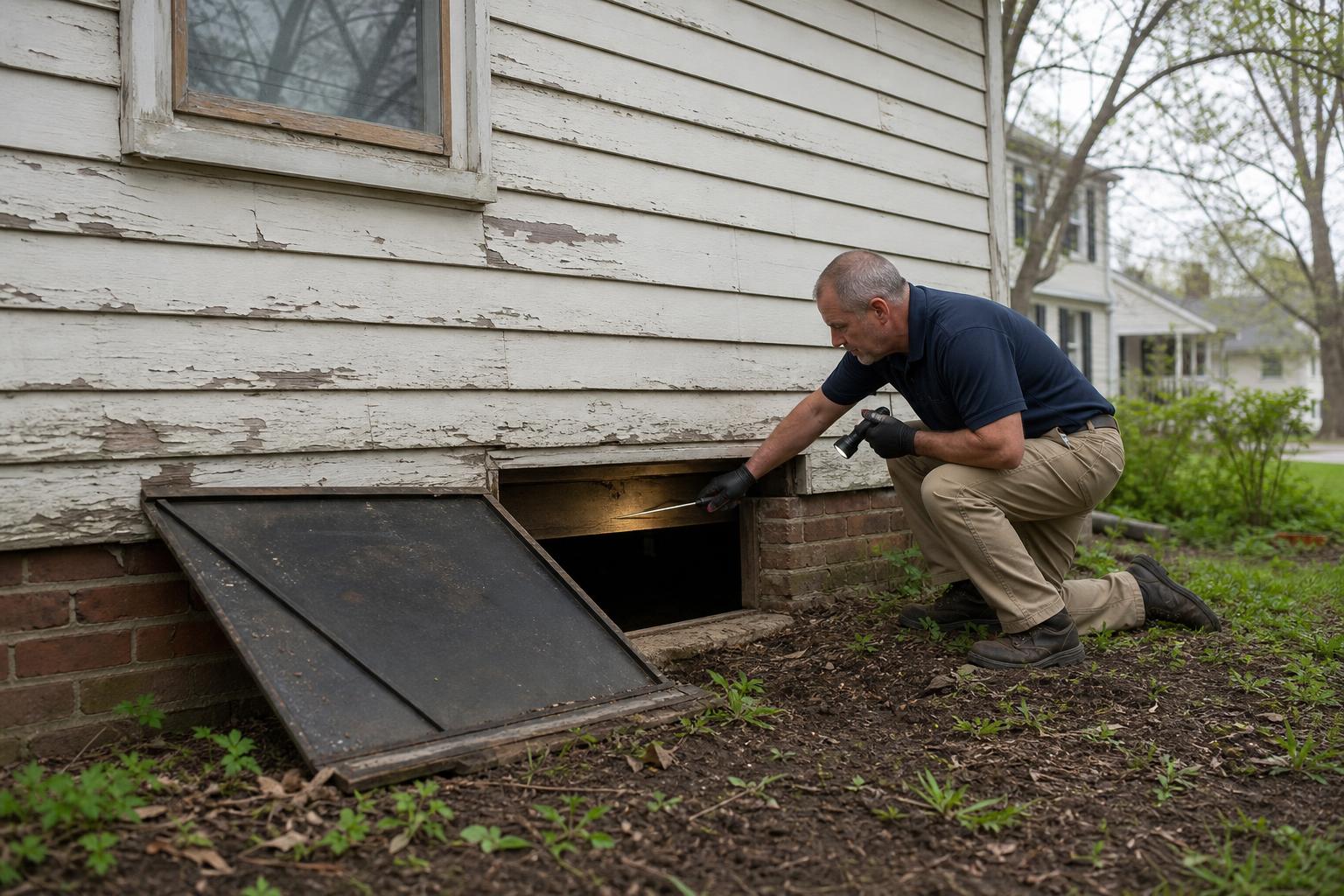
Two kinds of people call us about a termite inspection in Evansville: homeowners who found swarmers or a mud tube and want a licensed person to look, for free, and buyers, sellers, agents and lenders who need a wood-destroying insect (WDI) report for a closing in Indiana. Richard, our owner, holds the Indiana 7B termite license and does both himself.
- InspectorRichard, owner, Indiana 7B termite license
- Homeowner inspectionFree, with a written quote only if treatment is needed
- WDI reportThe standard Indiana WDI report form, for real-estate transactions
- ServingEvansville and Southwest Indiana
Why you are looking for a termite inspection
You saw something. Small dark winged insects on a sill one damp spring morning. A pile of shed wings by a door. A line of dried mud running up a block wall in the garage. You are not sure whether it is termites, flying ants or old damage, and you would like someone who knows the difference to tell you plainly.
You are closing on a house. The buyer’s lender or agent has asked for a wood-destroying insect inspection, there is a date on the calendar, and nobody wants a surprise the week before. You need a licensed inspector to look at the property and put what he found on the standard Indiana WDI report form.
Either way, the person who shows up is the owner, licensed for termite work in Indiana, not a salesperson with a clipboard.
What a termite inspection covers
Subterranean termites live in the soil and come up into the house wherever wood, moisture and ground meet. So that is where we look, and most of it is in places you do not normally go.
Exterior foundation and grade
We walk the full perimeter looking for mud tubes, wood siding or trim touching soil, mulch or firewood against the house, and grading that keeps the soil wet at the foundation.
Crawlspace or basement
Richard goes in with a flashlight and a probe. Sill plates, band joists, floor joists and support piers are checked for tubes, damage, moisture and wood-to-soil contact. This is where most Southwest Indiana termite activity is found.
Garage and slab joints
Garages and slab homes get termites through expansion joints, bath traps and plumbing penetrations that are never visible from outside. We check the joints, wall bases and any framing on the slab.
Interior
Baseboards, window and door frames, behind the tub, under sinks, and anywhere plumbing comes through the floor. We look for blistered paint, hollow trim, shed wings and live insects.
Moisture and conducive conditions
Leaks, condensation, poor crawlspace ventilation and wet soil are what bring termites to a house. We note them, because fixing them is part of keeping termites out.
Probing, sounding and showing you
Suspect wood gets probed and tapped. Then we show you what we found: the tube, the damaged sill, the entry point, how active it looks. If it is carpenter ants or old, inactive damage, we say so.
What a WDI report is, and who asks for it
A wood-destroying insect report is a written inspection document used in real-estate transactions. It is most often requested by the buyer’s lender or agent, and sometimes by a seller who wants to get ahead of the question before listing. A licensed inspector completes it on the standard Indiana WDI report form.
The report is not a guarantee that a house has no termites. It documents what was visible and accessible on the day of the inspection:
- Visible evidence of wood-destroying insects. Subterranean termites first, but also carpenter ants and powderpost beetles, both common in older Evansville houses.
- Evidence of prior treatment. Drill holes in the slab or foundation, bait stations in the yard, and any records the seller can provide.
- Visible damage, whether it looks active or old.
- Conducive conditions. Wood-to-soil contact, moisture problems and crawlspace debris that make a house attractive to termites even if none are present today.
- Areas that could not be inspected, such as a finished basement wall or a blocked crawlspace access.
Scheduling around a closing
We schedule WDI inspections around closing dates, so call with your date and the property address. Agents are welcome to call on a client’s behalf. If the seller needs to arrange access to a crawlspace or garage, tell us up front so the report is not marked incomplete for something that could have been opened.
Free inspection or WDI report: which one do you need?
If you own the house and want to know whether you have termites, you want the free inspection. If a house is changing hands and a lender, agent or contract requires a written report, you need the WDI report. The report is a paid document that becomes part of the transaction file, and we give you a written quote for it when you call rather than a number here that turns out to be wrong for your property.
| Free homeowner inspection | WDI report | |
|---|---|---|
| Purpose | Find out whether you have termites, and what to do about it | Document wood-destroying insect evidence for a real-estate transaction |
| Who requests it | The homeowner, or a landlord or property manager | Buyer’s lender, buyer’s agent, seller, or the purchase contract |
| Who inspects | Richard, Indiana 7B licensed | Richard, Indiana 7B licensed |
| What you get | Evidence shown to you on site, a plain explanation, and a treatment quote only if needed | The completed standard Indiana WDI report form for the lender, agent and title company |
| Timing | Usually within days of your call | Scheduled around your closing date; call with the date |
| Cost | Free | Quoted when you call |
If we find termites
Finding activity is not a crisis. Subterranean termites work slowly, and a house with a mud tube this spring can be treated this spring. For homeowners, Richard shows you what he found and gives you a written quote for the treatment that fits your house, a liquid barrier, a bait station system, or both. The details are on our termite treatment page.
For a transaction, a finding on the WDI report usually means the buyer and seller negotiate who pays for treatment. We can quote it at the same time as the report so nobody waits on a second visit, talk to either agent directly, and document the work once it is done.
If we find nothing, we say so. A clear inspection is a good outcome. Where a house has conducive conditions but no activity, we point them out, and our termite prevention page covers what to fix.
Saw swarmers? Closing soon? Get a licensed inspector out.
Homeowner inspections are free. WDI reports are scheduled around your closing. Either way, Richard looks himself.
Termite services
Termite control in Evansville
How termites get into Southwest Indiana homes and how we handle them.
Termite treatment
Liquid barriers, bait stations, and how we choose between them for your house.
Termite prevention
Moisture, grading and wood-to-soil contact: what keeps a treated house clear.
Termite inspection questions, answered plainly
Is the termite inspection really free for homeowners?
Yes. If you own the house and want to know whether you have termites, Richard comes out, inspects, shows you what he found and explains it, at no charge. You only get a quote if something needs treating. The WDI report for a real-estate transaction is a separate, paid document.
What is the difference between a termite inspection and a WDI inspection?
The looking is the same. The difference is the output. A homeowner inspection ends with a conversation and, if needed, a treatment quote. A WDI inspection ends with the standard Indiana WDI report form, a written record a lender, agent or title company can rely on for a closing.
Who orders the WDI report, the buyer or the seller?
Most often the buyer’s side, because the buyer’s lender or agent is asking for it. Sellers sometimes order one before listing. Who pays is whatever the purchase contract says. Any of them, or the agent on their behalf, can call us to schedule.
How long does a termite inspection take?
It depends on the house. A slab ranch goes faster than an older two-story with a full crawlspace and a basement. Plan on Richard being there long enough to get into the crawlspace, walk the perimeter, check the interior and walk you through what he found. On a closing deadline, call with the date and we will schedule accordingly.
I saw winged insects. How do I know if they are termites or ants?
Termite swarmers have straight antennae, a thick waist and two pairs of wings the same length. Flying ants have bent antennae, a pinched waist and front wings longer than the back. If you are not sure, keep a few in a bag and we will identify them at the inspection. Our guide on termites vs. flying ants has a side-by-side.