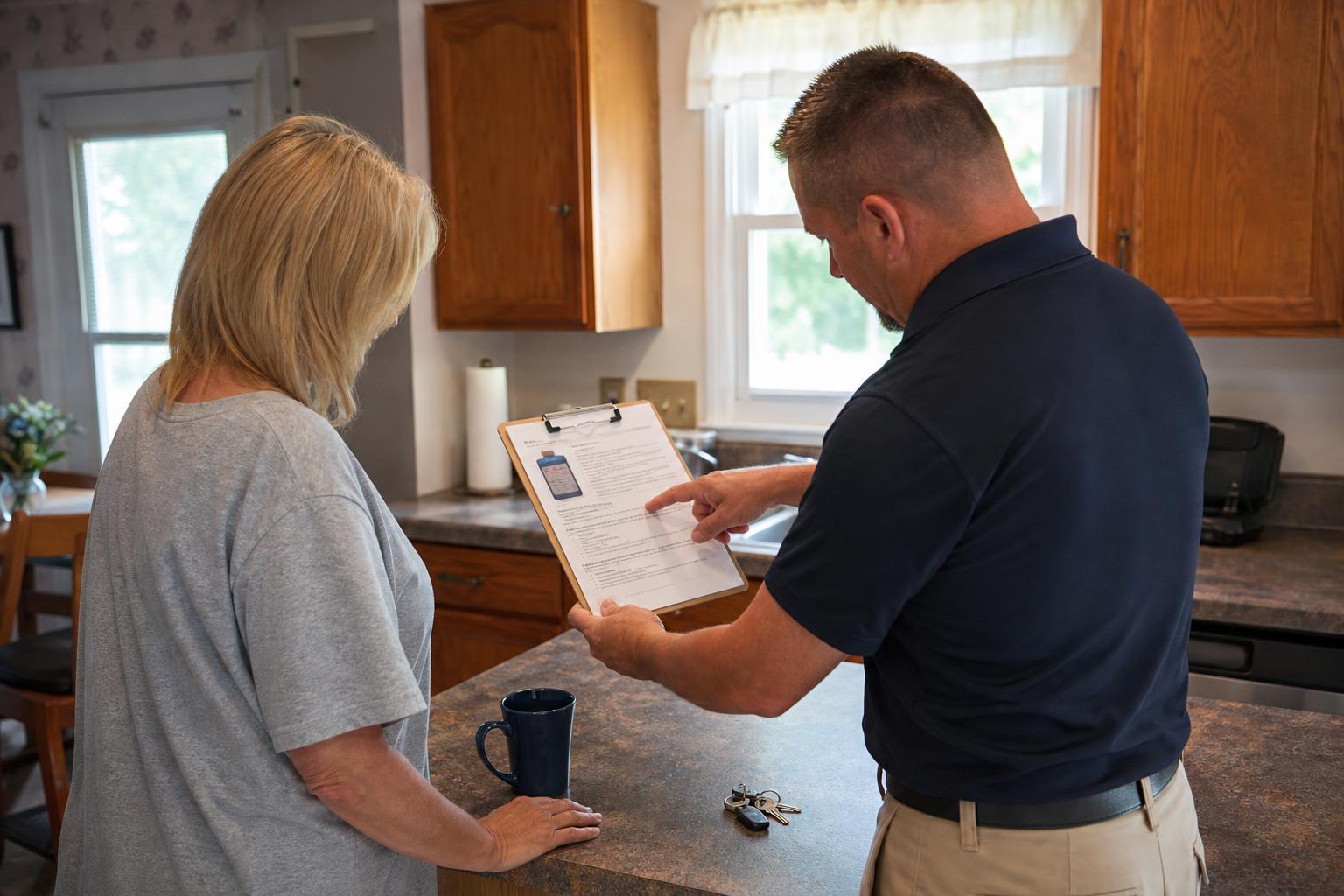
Probably, yes. “Is my exterminator lying?” is a common question after a treatment, and the honest answer is that you usually cannot see good pest control work. Dusts go into wall voids you would only open during demolition. Non-repellent products are invisible on purpose. Baits are the size of a grain of rice. So judge a technician by how well they explain the job, what they put in writing, and whether the problem goes away, not by what you can see on the baseboard.
- Most work is invisibleDusts, non-repellents and baits are meant to be
- Judge byExplanation, paperwork and results
- Check a licenseOffice of the Indiana State Chemist, Purdue
- Second opinionFree inspection, no pressure
Things that look like nothing but are the job done right
- Dust in wall voids and behind outlet covers. Insecticide dusts are applied into hollow spaces, not onto surfaces. A visible pile on the floor is sloppy. Nothing visible at all is usually correct.
- A thin non-repellent band you cannot see. Products for ants, roaches and termites are designed so the insect walks through unaware and carries it back to the colony. Dry, it is clear and odorless. That is the point.
- Gel bait dots. Roach and ant baits go on in dots smaller than a pea, tucked into hinges and under sinks. A good placement is one you have to hunt for.
- Bait stations that look untouched. “No activity” at a rodent or termite station is a result, not a skipped visit. The record of the check is what matters.
- A short visit for a simple problem. A targeted ant job in one kitchen can be done well quickly. What was inspected and applied is the better measure.
Things that actually are warning signs
- No inspection before a quote. A phone price for a problem nobody has looked at is a guess dressed up as a plan.
- They will not tell you what they used. The product name is not a secret, and the label is public.
- No written record. What was applied and where should be on paper or in an email after every visit.
- “Today only” pricing. Pressure to sign on the spot is about the salesperson, not the infestation.
- A plan you cannot cancel or cannot understand. If the terms take longer to explain than the treatment, slow down and read them.
- Bed bugs sprayed with no follow-up plan. A single spray and a wave goodbye is the setup for the “I saw another one” call.
- A guarantee with no way to check it. Ask what it covers and who confirms the result.
How to check them, in Indiana
Indiana licenses pesticide businesses and the applicators who work for them, and the program is run by the Office of the Indiana State Chemist at Purdue. Three checks that need no expertise:
- Ask for the license number and the category. A licensed applicator can give you both on the spot, and you can verify them with the Office of the Indiana State Chemist. For termite work, the category is 7B.
- Ask for the product by its label name, then read the label. Every registered pesticide has a label that says where it can be used and how. If it does not list your situation, ask why.
- Ask who is coming back and when. A real plan has a next visit, a person to reach, and a record of what was done.
The questions that separate straight from slippery
| Question | A straight answer sounds like | A slippery answer sounds like |
|---|---|---|
| What did you find? | “Frass behind the dishwasher, live activity under the sink. Come look.” | “Oh, you’ve got a real problem. We see this all the time.” |
| What did you use? | The product name, where it went, and why that one. | “Our commercial-grade formula.” No name given. |
| Why can’t I see anything? | “It’s a non-repellent, it dries clear. That’s how it works.” | “You don’t need to worry about that.” |
| What is your license category? | “7A, and 7B for termites. Here’s the number.” | “We’re fully certified.” Nothing specific. |
| What happens if I still see bugs? | “Call me. Here’s what’s normal in the first two weeks, and here’s when we come back.” | “That never happens with us.” |
| How will I know it worked? | A specific check: a follow-up date, a monitor, an independent verification. | “Trust me, it worked.” |
| Do I have to decide today? | “No. The quote is good, take it home and read it.” | “This price is only good while I’m here.” |
What transparency looks like here
We built Canine-Detect around the idea that you should never have to wonder. Richard, the owner, holds Indiana 7A and 7B licenses and does most initial inspections himself. He walks you to what he finds and tells you what it is, including when it is not the pest you feared. We tell you the product by name, and every visit is recorded in writing.
For bed bugs, someone who does not work for us checks
After a bed bug treatment, an independent company, K9 Detections, sends a trained scent-detection dog and handler through your home. If the dog clears it, that is an answer you did not have to take on our word. K9-verified
You can read more about who we are and what happens at a first inspection, step by step, so nothing on the day is a surprise.
When to get a second opinion
If you have gone through the questions above and still feel uneasy, get another set of eyes on it. Our inspection is free, and a second opinion is a normal thing to ask for. Have a few things ready:
- Any paperwork or emails from the previous company, especially product names and dates
- Photos of what you have seen, with the date and the room
- A bug in a sealed bag or a piece of tape, if you have one
- Your questions, written down
Want a straight answer? Let the owner take a look.
Richard or our operations manager comes out, shows you what is there and explains it in plain language. Free, no pressure, no “today only.”
Common questions about trusting your exterminator
The technician was only here for a short time. Did they actually do anything?
Maybe. A simple, targeted job can be done well quickly. The better question is what was inspected and applied, and that should be in your service record. No record at all is the real concern, not the clock.
How do I verify a pest control license in Indiana?
Ask the company for the business license and the applicator’s license number and category. Pesticide licensing in Indiana is administered by the Office of the Indiana State Chemist at Purdue, and you can verify a license with them. For termite work, look for category 7B.
I still see bugs a week after treatment. Were they lying?
Not necessarily. Some activity in the first week or two is normal for many pests, because the product needs time to work through a colony. What matters is that the company told you this up front and has a follow-up plan. If they promised instant results and are now dodging your calls, that is different.
Will you tell me if the other company did a fine job?
Yes. Our inspection is an inspection, not a sales call. If we see a normal post-treatment picture, we will say so. If not, we will show you why and lay out what we would do instead.