Every spring in Southwest Indiana, on the first warm day after a rain, two very different insects take to the air. Both are dark, both have four wings, and both end up on the same Evansville windowsills. One is a flying ant, a nuisance. The other is a termite swarmer, which means a colony is feeding close by. Telling them apart takes a minute, and it decides whether you sweep them up or call someone.
- Look atWaist, antennae, wings
- Termite swarmerStraight body, straight antennae, equal wings
- Flying antPinched waist, elbowed antennae, unequal wings
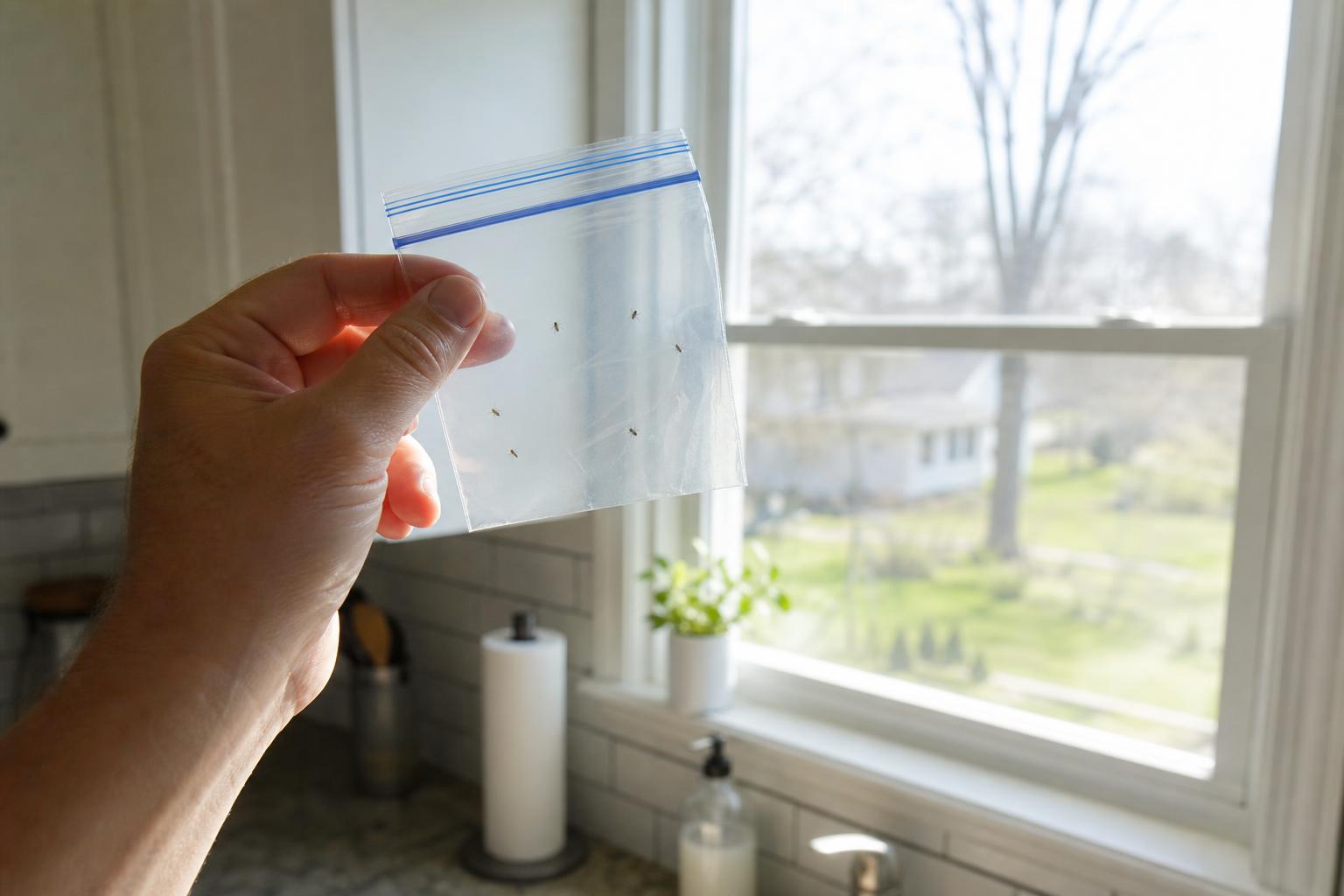
- Not sure?Bag one; Richard identifies it for free
The three-part check
Hold the insect, or a photo of it, up to a window and look at three things. Any one will usually settle it.
1. The waist
A termite swarmer has a straight, thick body, like a grain of rice with legs, with no narrowing between the middle and the back end. A flying ant has the pinched hourglass waist you picture when you think of an ant. This is the fastest tell.
2. The antennae
Termite antennae are straight or gently curved and look like a string of tiny beads. Ant antennae have a sharp bend in the middle, like an elbow. If you can see that angle, you are looking at an ant.
3. The wings
Termite swarmers carry two pairs of wings of equal size and shape, roughly twice the length of the body, and they shed them easily. That is why the usual find is a small pile of identical clear wings on a sill or in a tub. Flying ants have a front pair noticeably longer than the back pair, closer to body length, and they tend to keep them on.
Termite swarmer vs. flying ant, side by side
| Feature | Termite swarmer | Flying ant |
|---|---|---|
| Waist | Straight, thick, no narrowing | Pinched hourglass waist |
| Antennae | Straight, beaded | Elbowed, bent in the middle |
| Wings | Two equal pairs, about twice the body length | Front pair longer than the back pair |
| Color | Dark brown to black, wings clear or smoky | Black, brown or reddish, wings clear with a brownish tint |
| When they swarm here | Spring, a warm day after rain, usually daytime | Spring into summer, warm days and evenings |
| Where you find them | Windowsills, bathtubs, near doors, coming out of a wall or floor crack | Around wall voids, window frames, damp wood, outdoor lights |
| Wings left behind | Piles of identical wings, all one size | Few shed wings; those you find are two different sizes |
| What it means | A mature colony nearby; indoors means in or under the house | A nest nearby; carpenter ants point to moist wood |
When and where they swarm in Indiana
The termites around Evansville are eastern subterranean termites, and they swarm in spring. The trigger is weather: a warm, humid day, often the first after a soaking rain. A mature colony pushes out its winged reproductives over an hour or two, and they head for light. Outdoors, you see them rising from the soil near a foundation, a stump or a woodpile. Indoors, they come out of a crack in a wall, floor or window frame and pile up at the nearest window.
Swarmers inside the house are the one sign that is not ambiguous
Termite swarmers do not fly in through an open door in any number. A swarm, or a pile of identical wings, inside your home means the colony is in the structure or in the soil under it. The house is not falling down, but the colony has been feeding long enough to mature, and it is worth having someone licensed look now rather than next year.
Flying ants overlap the same season but run later. Carpenter ants, the ones that matter for a house, swarm from spring into summer and come out of wall voids, window frames, porch posts and any wood that stays damp. Other ants swarm on warm summer evenings and gather under porch lights. A few flying ants on a screen after dark are almost always outdoor ants passing through. A cluster coming out of your wall in daylight is worth a closer look, whichever insect it turns out to be.
How to get a sample identified
The most useful thing you can do is keep one. Swarmers drop their wings within an hour, and a vacuumed-up swarm leaves nothing to look at.
Do not spray first
Aerosol scatters the swarm, ruins the sample and does nothing to the colony that sent it. It also hides where they came out, which is the detail that matters most.
Collect a few in a zip bag or on tape
Two or three insects, and any wings you find, in a sealed sandwich bag. A strip of clear tape pressed over a wing pile works too. Note the room and the spot they came out of.
Take a photo next to a coin
A phone photo in window light with a penny beside the insect for scale is often enough for a first read.
Book a free inspection
Richard, our owner, holds Indiana 7A and 7B licenses and does most first inspections himself. He identifies the sample, checks the foundation and crawl space, and tells you plainly what he found. See termite inspection and WDI reports for what the visit covers.
What each one means for your house
If it is a termite
A swarm is the visible end of a colony that has been quietly working for a while. The next step is finding out where: mud tubes on the foundation, damaged sills, soft wood in the crawl space. Our guide to the signs of termites in Southwest Indiana homes covers what to check yourself, and our termite control page explains how we treat a colony once we find it. If the news is good, you will hear that too.
If it is a carpenter ant
Carpenter ants do not eat wood, but they tunnel through it, and they choose wood that is already damp. A carpenter ant swarm from inside a wall is two problems: an ant nest to treat, and a moisture source to find, whether a slow leak, a wet window frame or a crawl space that never dries out. Fix the ants without the moisture and they come back. Our residential and commercial pest control service covers ants, and we point out the wet spot while we are there.
Found swarmers or a pile of wings? Let a licensed expert identify them.
Richard, Indiana 7B termite licensed, comes out, looks at your sample and your foundation, and tells you what it is. Free, no pressure either way.
Swarmer questions, answered plainly
I only found wings, no insects. Can you still tell which it was?
Usually, yes. Termite wings come off in piles and every wing is the same size and shape. Ant wings are rarely shed in numbers, and the few you find will be two different sizes. A pile of identical wings on a sill or in a bathtub is one of the most common ways a termite colony gets discovered.
Termite swarmers came out inside my house. Is it an emergency?
It is not a same-hour emergency, but it is not something to put off. Indoor swarmers mean the colony is in or under the structure and has been there long enough to mature. Termites work slowly, so a few days to schedule an inspection changes nothing. A year does.
I saw swarmers outside near my foundation but not inside. Do I still need to worry?
A swarm rising from the soil next to the house means a mature colony is close, and subterranean termites forage well beyond the nest. It does not prove they are in the house, but it is the right moment to have the foundation and crawl space checked for mud tubes. Finding nothing is a fine outcome.
Can I just spray the swarmers and be done?
Spraying kills the ones you see and does nothing to the colony, which is in the soil or the wood, not on your windowsill. It also destroys the evidence we would use to identify them. Vacuum them up if you need to, keep a few in a bag, and skip the aerosol.
Are carpenter ants as serious as termites?
Not usually, but they are not nothing. Termites eat wood and can keep going for years unseen. Carpenter ants hollow out damp wood to nest in, so the damage is slower and tied to a moisture problem you can fix. A carpenter ant swarm mostly tells you something in the house is staying wet.