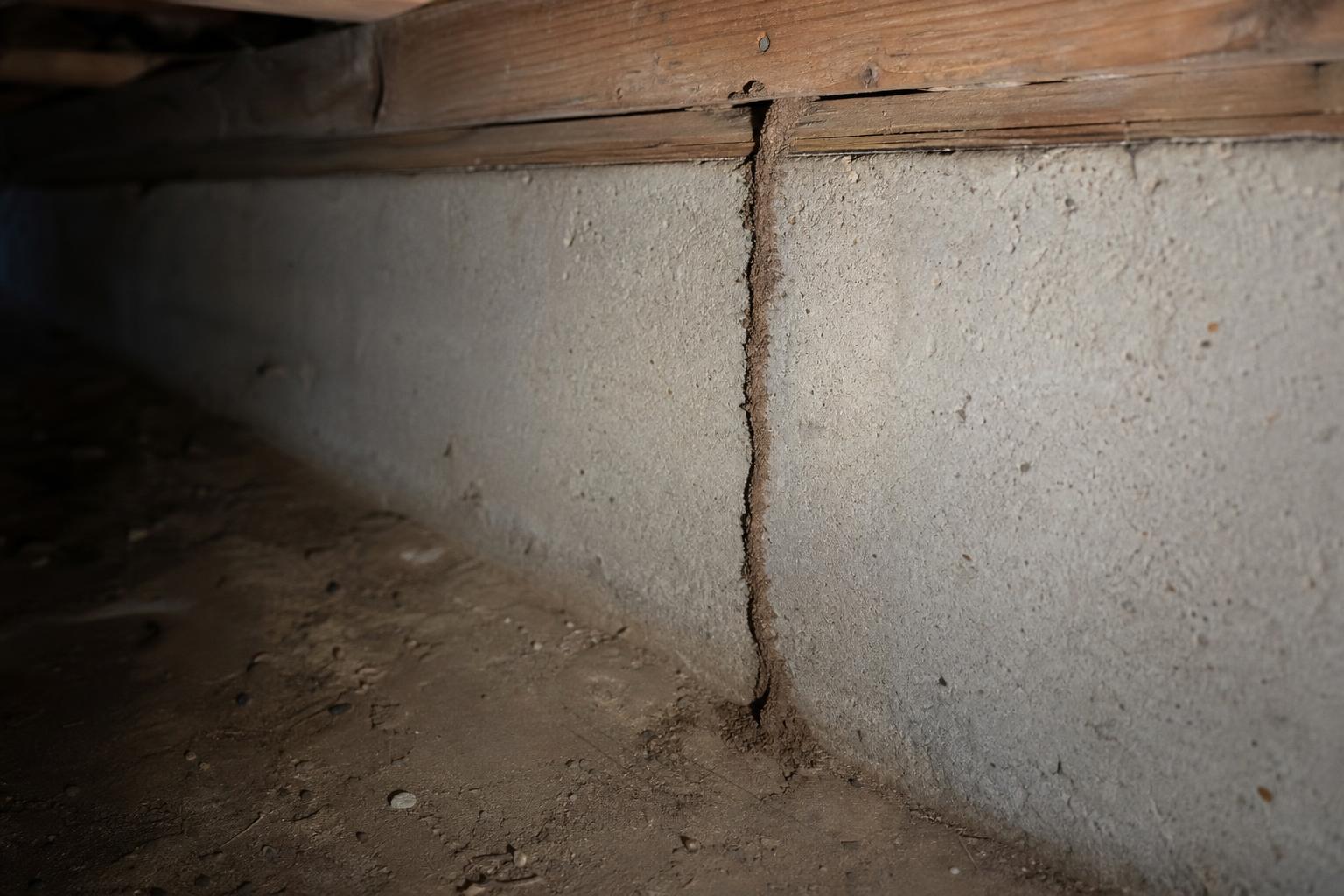
The termites around Evansville are eastern subterranean termites. They live in the soil, come up through the foundation, and eat wood from the inside out, so you almost never see them. What you see is what they leave behind. The signs are indirect and easy to mistake for something else. Here is what to look for, where, and what to do if you find it.
- Swarm seasonSpring, on a warm day after rain
- Clearest signPencil-width mud tubes on the foundation
- Hidden signWood that sounds hollow or gives under a screwdriver
- Inspected byRichard, Indiana 7B termite licensed, free
The signs, in the order people usually notice them
Most callers saw one of these five things. By the time you see a swarm, the colony has usually been feeding for a while.
1. Swarmers indoors, or piles of identical wings on a windowsill
In spring, usually on the first warm, humid day after a rain, a mature colony sends out winged swarmers. They are dark, about a quarter inch long, and head for light, so you find them on windowsills, in bathtubs, or around a door. They drop their wings within an hour or so, which is why the more common find is a pile of identical clear wings on a sill. A swarm inside your house means the colony is inside or under it.
2. Pencil-width mud tubes on the foundation, piers, or basement walls
Subterranean termites dry out in open air, so they build covered tunnels of soil between the ground and the wood. The tubes are brown, pencil-width, and run up a foundation wall, a block pier, or a pipe to the sill plate or joists. Look in the crawlspace, inside basement walls, and on the outside foundation behind shrubs and mulch. A tube can be active or abandoned; leave it alone until it has been inspected.
3. Wood that sounds hollow or gives under a screwdriver
Termites eat along the grain and leave the surface intact, so a sill plate or joist can look fine and be mostly gone inside. Tap a suspect board with a screwdriver handle and listen for a papery, hollow sound, then press the tip in gently. Sound wood resists; termite-eaten wood gives way and shows layered galleries packed with dried mud. Trim, door jambs, and window frames are common spots.
4. Blistered or bubbling paint and sagging floors near moisture
Termites carry moisture into the wood, and it pushes on paint and drywall from behind. The result looks like water damage: bubbling paint on a baseboard, a soft spot near a bathroom or kitchen, a door that suddenly sticks, a spongy floor over the crawlspace. Any of these can be a leak instead, which is why they get ignored. Moisture and termites go together, so soft wood in a wet area deserves a look either way.
5. Mud in cracks and around plumbing penetrations
Termites seal the openings they travel through. Look for packed, smooth patches of dried mud in foundation cracks, where a porch slab meets the house, around pipes coming up through a slab, and behind a tub or shower drain.
Where to look in a Southwest Indiana house
Evansville has older wood-frame houses on crawlspaces, brick ranches on slabs, and everything in between. Each has its own weak points.
| Area | What to check | Why it is a hot spot |
|---|---|---|
| Crawlspace | Tubes on walls and piers, the sill plate, joists near plumbing, wood debris on the soil | Damp, dark, close to the ground. Wood-to-soil contact and old form boards feed a colony for years unseen. |
| Basement | Inside face of the walls, the sill on top of them, around the sump, joists above the furnace and water heater | Termites follow the wall up from the footing. Sump and utility moisture keeps the wood attractive. |
| Slab home | Baseboards and door jambs, bubbling paint at floor level, slab cracks, pipes under sinks and behind the tub | No crawlspace means no visible tubes. They come up through slab cracks and plumbing gaps straight into the wall. |
| Porch and deck | The joint where the slab or deck ledger meets the house, posts set in soil, steps on the ground | Porches trap soil and moisture against the house; a deck ledger is a bridge to the rim joist. |
| Garage | Bottom of the door trim, cardboard and lumber stored against the wall, the joint at the house wall | Trim touching concrete and stacked cardboard give termites food and cover. |
Things that look like termite signs but are not
Part of a good inspection is telling you it is not termites.
- Carpenter ants and their sawdust. Carpenter ants tunnel through wood but do not eat it, so they push out neat piles of dry sawdust. Termite galleries are packed with mud.
- Flying ants. Ants swarm too, and from across the room they look the same. Termite swarmers have straight antennae, a thick waist, and four equal wings; ant swarmers have a pinched waist and longer front wings. Our guide on termites vs. flying ants walks through it.
- Water damage. A leak produces the same bubbling paint and soft wood, minus the mud and galleries. Fix it anyway; wet wood is what termites look for.
- Powderpost beetles. Small round pinholes in hardwood with fine powder underneath. A real wood pest, but not termites.
What to do if you find something
Before you call, five simple things
- Do not spray the swarmers and hope. Spray kills the ones you can see and does nothing to the colony.
- Do not disturb the mud tubes. So we can see where they lead and whether they are active.
- Bag a few insects or wings. A zip bag of swarmers or wings settles the termite-or-ant question in seconds.
- Take a photo. Swarmers are gone within a day. A picture of the sill or the tube helps when you call.
- Call for a free inspection. Richard, our owner, holds the Indiana 7B termite license and does most inspections himself. He shows you what he found and tells you plainly whether it is termites.
If it is termites, you get a written explanation of where the activity is and what we recommend; the work itself is described on our termite treatment page. Buying or selling a house? Ask for a formal WDI report rather than a plain look. Our termite inspection and WDI report page explains what lenders expect.
Saw wings, a tube, or soft wood? Get it looked at.
A licensed termite inspector, not a salesperson, comes out and tells you what it is. Free, across Southwest Indiana.
Questions people ask after finding termite signs
I found wings on a windowsill but no insects. Is that termites?
Quite possibly. Termite swarmers drop their wings soon after landing, so a pile of identical clear wings with no bodies is a classic find. Ant swarmers shed wings too. If all four wings in a set are the same length, think termites, and bag a few so we can confirm.
When do termites swarm in Southwest Indiana?
Mainly in spring, often on the first warm, humid day after a rain. A colony inside a heated house can swarm out of season. No swarm does not mean no termites; many colonies never swarm where you can see them.
The mud tube is dry and crumbly. Does that mean they are gone?
Not necessarily. Termites abandon and rebuild tubes all the time, and an old tube on one wall often means an active one nearby. An empty tube proves termites have been in the house, which is reason enough for an inspection.
Can I check for termites myself before calling?
Yes. A flashlight, a screwdriver, and twenty minutes in the crawlspace or basement will find the obvious signs. What a homeowner cannot easily judge is whether activity is current, how far it goes, or what is behind a finished wall. That is what the free inspection is for.
I am selling my house and the buyer wants a termite letter. Is that the same thing?
Close. A “termite letter” is usually a wood-destroying insect (WDI) report, a formal inspection on a standard form that lenders and buyers rely on, done by a licensed inspector. See our termite inspection and WDI report page for what it covers.