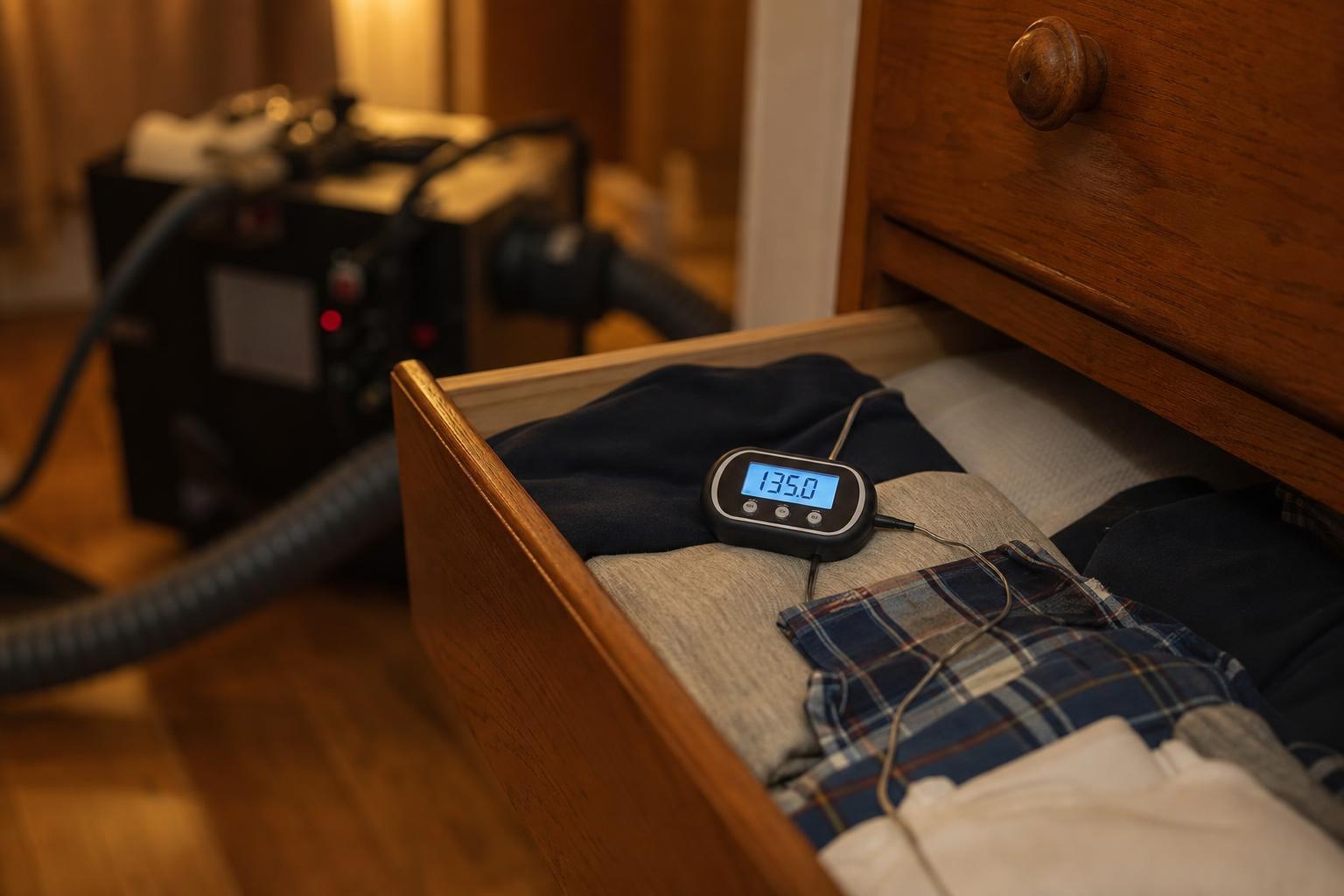
Heat kills bed bugs for a simple reason: they are small, soft-bodied, and they cannot leave the room. Push the furniture and the walls past the temperature their bodies can tolerate, hold it there, and there is nowhere to hide. The part most people miss is that “hold it there” matters more than the peak. Time at temperature does the killing.
- Lethal rangeRoughly 113 to 118°F, held long enough
- Toughest stageEggs, which need the longest exposure
- Our treatment24 hours at 135°F
- Checked byK9 Detections, an independent company
The temperatures that matter
Published university extension guidance puts the numbers in the same neighborhood. Adult bed bugs and nymphs die fairly quickly once held at roughly 113 to 118°F. Eggs are the tough stage. Their shell buffers them against short spikes, so they need a longer stretch at lethal temperature before they are dead rather than delayed. Every figure here is approximate on purpose. A lab is not a bedroom in Evansville with a queen bed, a dresser and a full closet.
Here is the catch behind almost every failed heat job we hear about: a thermometer in the middle of the room is not the temperature inside your box spring. The air can hit 130°F while the center of a mattress or the gap behind a baseboard is still in the 90s. The bugs are not in the air. They are in the places that heat up last.
Why the inside of your furniture lags the room
Anything with mass takes time to warm through. A mattress is foam and fabric, and foam is an insulator. A dresser full of folded clothes is stacked insulation. Heat moves from the air into the surface and then slowly through the material, and that last step is measured in hours, not minutes.
- Thermal mass. Solid headboards, dense mattresses and stacked belongings soak up heat before passing it along. The denser the object, the longer its core lags the room.
- Insulation. Fabric, foam, cardboard and piles of laundry all slow heat down. That is their job.
- Clutter. A closet floor covered in shoes and bags creates dozens of small pockets, each warming on its own slower schedule.
- Cold spots. Exterior walls, floors over a crawl space, and corners far from the heaters stay cooler than the center of the room, and bed bugs live along baseboards and in outlet boxes on exactly those walls.
This is why we do not trust a single air reading. Wired probes go into the coldest places we can find, deep in the box spring, inside drawers, low on an exterior wall, so the clock starts when the worst spot reaches temperature, not the easiest one.
What a few hours can miss
A short heat job can knock down a light infestation in an uncluttered room. But it bets on everything reaching lethal temperature inside a window the physics above does not always allow. Three things slip through most often.
First, cooler pockets. If the core of the box spring topped out at 105°F, whatever was in there is stunned, not dead. Second, eggs. A batch tucked into a screw hole in the bed frame can ride out a brief spike and hatch two weeks later. Third, retreat. As the room warms, bugs move away from the heat into wall voids and under floor edges, the slowest places of all.
Put those together and you get the call we hear constantly: quiet for three weeks, then someone saw a bug. That is not a mystery. It is a hatch date. Our guide on why bed bugs come back after treatment walks through how to tell an incomplete kill from a fresh introduction.
Why we hold 135°F for 24 hours
Two numbers, one reason each.
135°F gives us a margin. If the lethal point is roughly 113 to 118°F, running the room well above that means the slow spots still cross the line. It is also low enough that most household items come through fine: mattresses, furniture, clothing, bedding, books, powered-off electronics.
24 hours is the soak. A full day at temperature works through the mattress core, the drawer full of sweaters, the wall void behind the headboard and the corner along the exterior wall. It also outlasts an egg. There is no window for a bug to retreat and wait it out, because nothing in the treated space stays cool for a full day. That is the difference between hoping the heat reached everything and knowing it did.
A handful of items do not belong in a room at 135°F, so we pull them beforehand: candles, aerosols, some medications, certain plastics and a few electronics. The full prep list and the day-of schedule are on our bed bug heat treatment service page.
| Stage | What kills it (approximate) | Where it hides |
|---|---|---|
| Adult | Roughly 113 to 118°F, sustained; faster the hotter it gets | Mattress seams, box spring frame, headboard joints, baseboards, outlet boxes |
| Nymph | Similar to adults; warms through quickly once its hiding spot reaches temperature | Tight seams and screw holes close to where people sleep |
| Egg | Same lethal range but needs the longest exposure; a short spike may only delay hatching | Glued into fabric folds, wood grain, cracks in the bed frame, behind picture frames |
Heat and chemicals together
Heat has one honest weakness: no residual. Once the room cools, it offers no protection against a bug that walks in from the unit next door or comes home in a suitcase. So in specific situations, such as an apartment sharing walls with an untreated neighbor, we pair heat with targeted products where bed bugs travel. Not a fog, not a spray over everything, never a substitute for the heat. If you are weighing the two, read heat treatment vs. chemical spray for the plain comparison.
How you will know it worked
Someone who does not work for us checks
After the heat, K9 Detections, a separate company, brings a trained scent-detection dog through your home, looking for live bugs and viable eggs, the two things a short treatment leaves behind. If it clears the house, you have an answer that did not come from the people you paid. K9-verified
See our K9 inspection page, and how you will know your bed bugs are gone for the weeks after.
Want a licensed expert to look before you decide?
Richard or our operations manager comes out, finds what is there and explains what a 24-hour treatment would involve for your home. Free, no pressure.
Heat treatment questions people ask us
If bed bugs die at around 118°F, why not just run the room at 120°F?
Because 120°F in the air means the inside of your box spring may never get there. The lethal number applies to the hiding spot, not the room. Running at 135°F gives the slow places a margin without damaging most household items.
Will 135°F damage my mattress, furniture or electronics?
Mattresses, wood furniture, clothing and bedding come through fine. Most electronics are safe powered off. We remove the short list of things that are not; you get that list at the inspection.
Can bed bugs escape the heat by moving into the walls?
They try. As the room warms they retreat toward wall voids and floor edges, and a short treatment can end before those spots reach temperature. Over 24 hours the voids warm through too, so retreating only delays the outcome.
Does heat kill bed bug eggs?
Yes, given enough time. Eggs are the most heat-tolerant stage and need the longest exposure, which is why a few hours is a gamble and a full day is not. Eggs that survive a short job hatch two to three weeks later, which is when people call saying it came back.
Do I have to leave the house during the 24 hours?
Yes. The treated space is far too hot to stay in, and pets and plants come out as well. Timing and what to take with you are covered at the inspection and on the heat treatment service page.