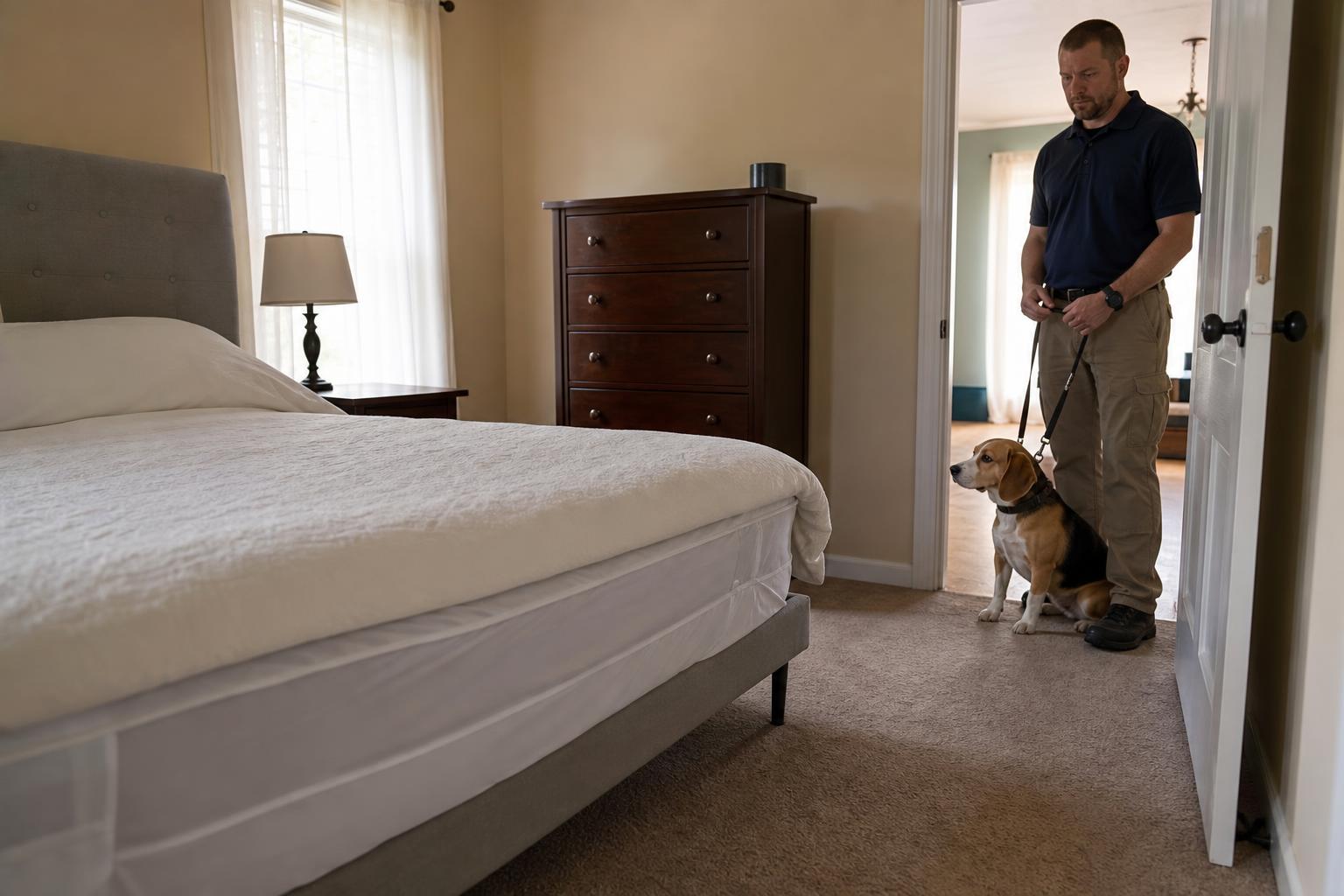
You paid for a treatment. The bites stopped, or mostly stopped. Now every itch and every speck on the sheet has you asking: did it actually work, or am I about to go through this again? Here is the calm answer, including why we have someone who does not work for us confirm the result.
- Watch windowRoughly 7 to 14 days after treatment
- What “clear” meansNo new bites, spots, skins or live bugs
- Who confirms itK9 Detections, an independent company
- Our treatment24 hours of heat at 135°F
What “it worked” actually looks like
Bed bugs leave a trail, so the trail going quiet is the first real sign, well before any inspection.
- No fresh fecal spots. Old dark marks on seams and box springs stay put after treatment, so photograph them on day one. You are watching for anything new.
- No new cast skins. Fresh, pale shed skins mean a nymph is still feeding. Old brittle ones from before treatment mean nothing.
- No live bugs or nymphs after roughly the first two weeks. The tiny pale nymphs matter as much as the adults. A clear home stops producing them.
- No new bite patterns. Not the same as “no itching.” Old bites can itch for a week or more, and anxiety makes every itch feel like a bite. New bites show up in fresh places, often in lines or clusters.
One more thing, because it causes a lot of panic: a single straggler in the first day or two after a heat job is not a failed job. A bug that was dying when the equipment came out can still crawl a short distance. Bag it, tell us, and do not conclude anything yet.
Why you cannot tell from a single bug
A bed bug found after treatment could be one of three very different things, and they look identical on your sheet.
- A survivor. A short treatment leaves cooler pockets inside furniture, behind baseboards and in wall voids. This is the one that means the job was incomplete.
- A reintroduction. A bag from a trip, a guest’s coat, a chair from the garage, or the apartment next door. The treatment did its job; something new walked in.
- An egg that hatched later. Eggs are the hardest thing for a quick job to kill. Held at temperature too briefly, they hatch a week or two later and you see nymphs. This is the most common story behind “it came back.”
Which one you have changes what should happen next, and you cannot sort it out by staring at the bug. That is why we do not let the answer rest on anyone’s opinion, ours included. The longer version is in why bed bugs come back after treatment. If you are holding one right now, start with I found a live bed bug three weeks after treatment.
The honest timeline
Every home is a little different, so treat this as a map, not a promise.
| When | What you may see | What it means | What to do |
|---|---|---|---|
| Day of treatment | Dead bugs and nymphs, a warm house, maybe a slow straggler | Normal. The heat did its work. | Leave encasements on. Bag any live bug. |
| First week | Old bites still itching, old spots still visible, nothing new | Expected. Skin and old evidence take time to settle. | Sleep in your own bed. Photograph anything new. |
| Days 7 to 14 | Nothing new, or a healthy, fast-moving bug or nymph | Quiet is the good sign. A healthy bug now deserves a closer look. | Call us either way. This is when the independent check happens. |
| After a clear K9 sweep | No alerts from the dog, nothing new from you | Clear of live bed bugs and viable eggs as of that visit. | Keep encasements on and call if anything changes. |
Why independent verification changes everything
Most companies check their own work. The technician who did the treatment comes back, looks around, and says it is clear. He may be right, but he is also the person with the strongest reason to say so. That is a company grading its own homework.
After our treatment, K9 Detections, a separate business with no stake in our result, sends a handler and a trained scent-detection dog through your home. The dog is trained on one scent, live bed bugs and viable eggs, and it cannot be talked into a clear. It works the mattress seam, the box spring and the gap behind the baseboard, places a flashlight never reaches.
What a clear sweep means, and what it does not
It means: on the day of the sweep, the dog found no live bed bugs and no viable eggs where it worked. That is your answer, from someone who was not paid to say yes. K9-verified
It does not mean: nothing can ever come home in a suitcase or from a neighboring unit. A clear sweep tells you the treatment worked. Staying clear is about what comes through your door afterward.
Verification only means something after a treatment that could plausibly have worked, which is why ours runs 24 hours at 135°F. More on our bed bug heat treatment and K9 inspection and independent verification pages.
What to do while you wait
- Keep the encasements on. They trap anything left inside and make new activity easy to spot. Leave them zipped for months, not days.
- Do not move rooms. The couch feels safer, but it draws anything left out of the treated area and into a new one. Stay in your bed, where you are watching.
- Do not bring furniture or bagged items back in yet. If it left the house before treatment, it did not get treated. Ask us first.
- Do not spray over the treatment. Sprays and foggers scatter bugs into walls and make the dog’s job harder. If you see something, the right tool is your phone.
- Call us if you see anything. A bug, a nymph, a new spot, a bite you are not sure about. We would rather look at nothing than have you spend a week guessing.
If the waiting itself is the hard part, our bed bug panic guide was written for that feeling.
Questions to ask any company
- How long do you hold the heat? A few hours is common. Ours is 24. Time at temperature is what reaches the eggs.
- What temperature, and where do you measure it? The air near the heater is not the inside of your couch. Ask how they know the cold spots got hot.
- Who verifies the result? “We come back and check” is a company grading itself. Ask whether anyone independent confirms it.
- What happens if I see one afterward? You want a plain answer with no hedging. Ours is: call, and we come look.
Vague answers last time? Read is my exterminator being straight with me?
Treated by someone else and not sure it worked? A second opinion is free.
Richard, our owner, or our operations manager comes out, looks at the evidence and tells you plainly whether you are clear. No charge, no pressure.
Questions people ask after a bed bug treatment
How long after treatment can I be confident the bed bugs are gone?
Give it roughly two weeks, long enough for any surviving egg to hatch and show itself as a nymph. If nothing new turns up and the independent K9 sweep is clear, you can stop holding your breath.
I am still itching a week later. Does that mean it failed?
Usually not. Old bites can itch for a week or longer, and stress makes ordinary itches feel like bites. Look for new bites in new places alongside fresh spots, skins or live bugs. Bites alone are the least reliable sign.
I found a dead bed bug after treatment. Is that a problem?
No. Dead bugs are what a heat treatment produces, and they turn up for days as you vacuum. A live, fast-moving bug or a pale nymph is the thing to call about.
What happens if the K9 alerts after your treatment?
Then we go back to work. The handler shows us where the dog alerted, we inspect that spot and we address it. You are not left arguing about whether the job is finished; the dog already answered.
Another company treated my home. Can you tell me if it worked?
Yes. Start with a free inspection. Richard or our operations manager looks at what is there and tells you honestly where things stand. If it makes sense, we arrange a K9 detection inspection so you have an independent answer, not a guess.