This is the practical page. If you are booking a bed bug heat treatment in Evansville, or weighing us against a shorter job, you want to know what actually happens in your house: what we bring, what you have to move, how hot it gets, how long it stays that way, and how you find out it worked. Here it is, hour by hour.
- Hold time24 hours
- Target temperature135°F
- Checked byK9 Detections (independent)
- Inspected byRichard, owner, Indiana 7A + 7B licensed
The question behind the question
Most people who call about heat already know it works. What they are really asking is narrower. Will my mattress survive it? Do I have to bag up everything I own? Why does one company say a few hours is plenty and another say a full day?
The answers come down to one idea: heat kills bed bugs only where it reaches, and only if it stays there long enough. Everything about our treatment day follows from that. Our bed bug control page covers the service overall. This one is about the treatment itself.
What the treatment day looks like
Morning, day one: arrival and setup
Our crew arrives with electric heaters and high-volume fans. We walk the rooms with you, check the prep list is done, and pull furniture off the walls so air can move behind it. Drawers and closet doors open, cushions stand on edge.
Sensors go in the coldest spots
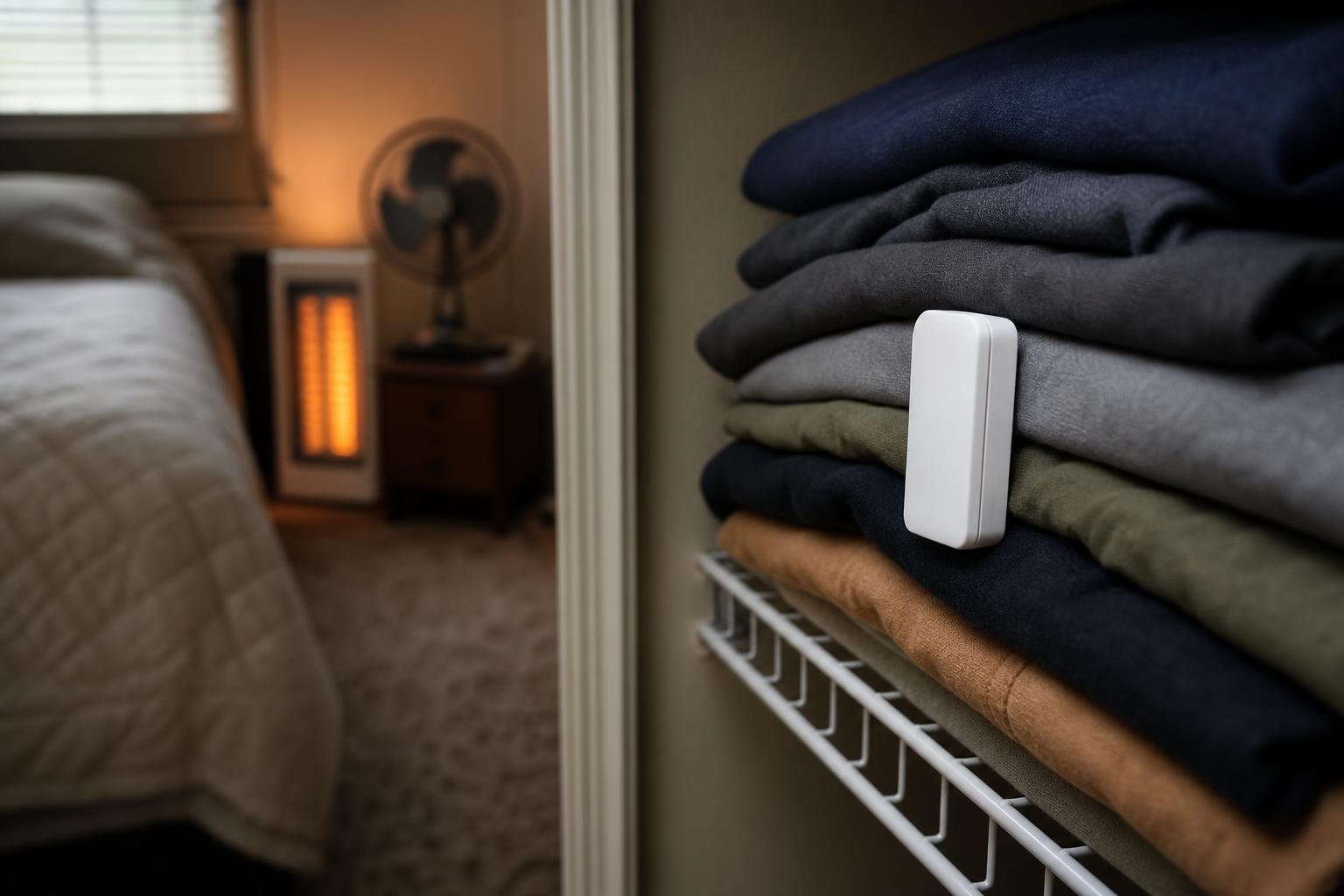
Before anything warms up, we clip wireless temperature sensors where heat arrives last: inside a closet on a stack of folded clothes, in the middle of a box spring, deep in a sofa, inside a dresser drawer. We measure the places bugs hide, not the air in the middle of the room.
Ramp-up
The heaters bring the space up gradually while the fans push warm air into voids, seams and furniture. A small apartment climbs faster than an older two-story with plaster walls. The clock does not start until the coldest sensor reads target.
The hold: 24 hours at 135°F
Once the sensors read 135°F, the clock starts and we hold it there for a full 24 hours, watching the sensors and moving fans if a cold spot shows up. This is the part most companies shorten. We do not.
Cool-down and walk-through
The heaters come off and the house cools over a few hours. We move furniture back, show you what we saw, and go over the next two weeks: what a straggler looks like, what to do if you see one, and when the dog comes.
Independent K9 verification
K9 Detections, a separate company, sends a handler and a trained scent-detection dog through the treated rooms. A clear from a dog with no stake in the outcome is a real answer. Details on our K9 inspection and verification page. K9-verified
Your prep checklist
You get this in writing at the inspection, tailored to your home. It is shorter than people expect, because the heat treats most of your belongings where they sit.
Take out of the treated rooms
- Aerosol cans of any kind: hairspray, deodorant, cleaning sprays, spray paint.
- Candles, crayons, wax and anything else that melts, including lipstick and some cosmetics.
- Medications and vitamins. Seal them in a bag first so you are not carrying bugs out with them.
- Heat-sensitive electronics we flag on the list, plus vinyl records, film and musical instruments.
- Food that spoils, wine and carbonated drinks.
- Pets and plants. Fish tanks too. The house is not safe for anything living for the full day.
Leave in place
- Bedding, mattress and box spring. The heat treats them. Pull the sheets loose rather than bagging them.
- Clothes, shoes and closets. Leave them, but loosen packed shelves and drawers so warm air can move through.
- Furniture. Sofas, dressers, nightstands and headboards stay. This is where the bugs are and what the 24 hours is for.
- Books, toys, luggage, bags. Open them up rather than carrying them out. Anything that leaves untreated can bring the problem back.
One rule covers most edge cases: if you would not leave it in a parked car in July, take it out. If you are not sure, ask us instead of throwing it away.
Why 24 hours, not a few
Bed bugs die at sustained temperatures in the 113°F to 118°F range. Eggs are tougher and need longer. So a treatment that reaches 135°F in the air and holds it for a few hours will kill what is exposed, and plenty of companies advertise exactly that. On paper it sounds like enough.
The catch is that the air temperature is not the temperature inside a box spring, a stuffed sofa, a stack of sweaters or a wall void. Those spots lag by hours. A short job can hit target in the middle of the room while the center of the mattress is still comfortable for a bug. That is where survivors and viable eggs come from, and why people who searched “bed bug heat treatment Evansville” once are often searching it again a month later.
Holding 135°F for a full 24 hours, measured in the cold spots, removes the guessing. The heat soaks all the way into furniture, clutter and voids, and eggs get the exposure they need. More on the science in Bed bug heat treatment explained: why 24 hours at 135°F.
What heat does not do
Heat has no residual. Once the house cools, nothing is left behind to stop a bug that arrives next week in a backpack or walks over from a neighboring apartment. Heat is the most thorough way to kill what is in the home on treatment day. It is not a barrier against what comes later.
So we sometimes pair the heat with targeted products in specific places, such as a light residual along a shared wall in an apartment building, and we tell you when and why. It is a call Richard makes at the inspection, not a default add-on. If your question is spray versus heat, see heat treatment vs. chemical spray .
A few hours versus 24 hours, side by side
| Short heat job (a few hours) | Canine-Detect (24 hours at 135°F) | |
|---|---|---|
| Where the temperature is measured | Usually the room air | Wireless sensors in the coldest spots: closets, box springs, sofa interiors, drawers |
| Deep furniture and wall voids | Reached partially, depending on the house | Reached, because the heat has time to soak in |
| Eggs | Killed where the heat arrived in time | Killed, given the long exposure |
| Typical follow-up | Repeat visits when bugs reappear | A phone call if you see anything in the first weeks |
| How you know it worked | You wait and watch | An independent K9 team clears the home |
- Indiana 7A + 7B licensed
- Technicians certified through the Office of the Indiana State Chemist
- Fully insured
- Independent verification by K9 Detections
Want to know what your treatment day would look like?
Richard comes out, confirms it is bed bugs, walks the rooms and hands you a written prep list and quote. Free, no pressure.
More on bed bugs
Bed bug control in Evansville
Inspection, treatment, verification and cost, in one place.
K9 inspection and verification
How an independent scent-detection dog confirms the home is clear after the heat.
Apartments, rentals and businesses
Heat in multi-unit buildings: adjoining units and tenant prep.
Heat treatment questions
Do I have to leave the house for the whole 24 hours?
You need to be out of the treated rooms, which in most homes means out of the house, for the ramp-up, the hold and the cool-down. Plan on being away treatment day and the following day, and take pets and plants with you. We give you a realistic return time.
Will 135°F damage my furniture, TV or walls?
Ordinary furniture, mattresses, clothing, drywall and paint handle it fine. The items that do not are on the prep list: aerosols, candles and wax, medications, some electronics and anything that melts or is pressurized. If an item worries you, ask us.
Why not just run it hotter for a shorter time?
Because the limiting factor is how long the inside of a mattress or a wall void takes to catch up, not the air temperature. Running hotter raises the risk to your belongings without changing that. Time at temperature is what reaches the eggs and the deep spots.
Should I wash and bag all my clothes before you come?
No. Leave them in the closet and dresser, loosened so air can circulate. Carrying bags of clothes through the house is one of the most common ways people spread bed bugs, and the heat treats everything in place anyway.
What happens if the K9 alerts after the treatment?
We come back and deal with it. The handler shows us where the dog alerted, we inspect that spot and treat what is there. The point of an independent company is that the result is real either way: a clear is a clear, and an alert gets handled instead of argued about.