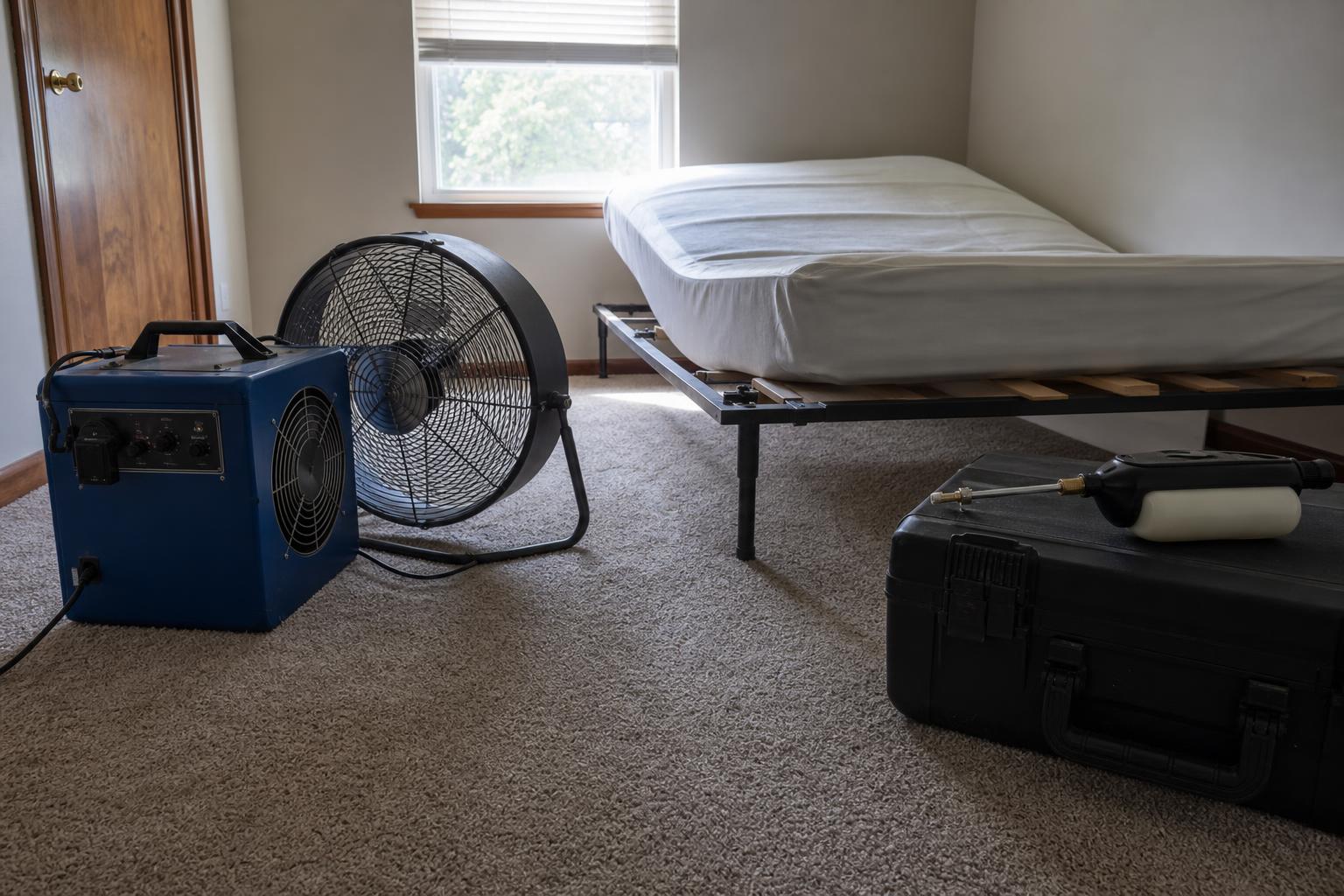
The short version: heat kills every life stage it reaches, eggs included, in one visit, and bed bugs cannot build resistance to it. Chemicals leave a residual that heat cannot, but only work where they land, and many bed bug populations now shrug off the common ones. For most homes in Evansville and Southwest Indiana, the honest answer is thorough heat with real time at temperature, plus targeted products where there is a specific reason.
- HeatKills all stages it reaches; no resistance
- ChemicalLeaves a residual; works only where applied
- Our core24 hours at 135°F
- Checked byK9 Detections, an independent company
How each one works, in plain words
Heat
Electric heaters bring the room up past the point bed bugs can survive, and fans push that warm air into the mattress, the furniture, the baseboards and the wall voids. The bugs cannot leave the room, so once their hiding spot gets hot enough for long enough, they die in place. Adults, nymphs and eggs all go together, and nothing is left on your surfaces afterward. The weakness is just as simple: the moment the room cools, the protection is gone.
Chemical
“Chemical” covers a few different things. Contact products kill the bugs they touch and then they are done. Residual products leave a film that keeps working for weeks, so a bug that walks across it later still picks up a dose. Dusts go into places liquids cannot, such as outlet boxes and the gap behind baseboards, and they stay put for a long time.
The weakest version is the one most people get: a quick pass over the bed and along the baseboards, then out the door. Bed bugs hide in seams, screw holes, furniture joints and clutter, and a spray does nothing for the ones it never reached. Eggs are barely affected at all. Add resistance to common spray products, and you have the reason so many “they sprayed it” stories end with “and then they came back.”
The fair comparison
| Chemical only | Short heat job (a few hours) | 24-hour heat plus verification | |
|---|---|---|---|
| Kills eggs | Poorly | Only where the heat fully reached | Yes, given the time |
| Reaches wall voids and inside furniture | Dusts can; sprays cannot | Partially | Yes |
| Resistance issues | Yes, with many common products | None | None |
| Residual protection after | Yes, that is its strength | None | None from the heat; targeted product added when there is a reason |
| Number of visits typically | Several, spaced out | One, often with repeats | One treatment, then an independent check |
| Prep burden | Moderate, and repeated each visit | Moderate | Moderate, once |
| Chemical exposure in the home | Throughout treated rooms | None | Little to none; only in specific voids if used |
| How you know it worked | You stop seeing bugs | You stop seeing bugs | A trained dog from K9 Detections clears the home |
When chemicals genuinely help
Heat is the core of every bed bug job we do, but pretending chemicals have no place would be its own kind of dishonesty. Three situations where a targeted product earns its spot:
- A residual barrier in a multi-unit building. Heat clears your apartment, not the unit on the other side of the wall. If reintroduction from a neighbor is likely, a residual along the shared wall, the door threshold and the plumbing penetrations catches a wandering bug on its way in.
- Dust in outlets and voids after heat. After the heat, a light dust inside outlet boxes and deeper voids adds long-lasting insurance in the exact places a bug would travel, out of reach of kids and pets.
- When heat is impractical. Some spaces cannot be safely brought to temperature, or hold items that cannot be moved and cannot take the heat. There, a careful chemical program is the right tool, and we say so.
What we do not do is fog a house, spray everything “just in case,” or use a product in place of the heat.
Why time at temperature decides it
The heat-versus-chemical question usually comes down to eggs. A spray barely touches them, and a short heat job can leave a batch inside a bed frame stunned instead of dead, which is why so many “it came back” calls land two or three weeks later. Heat wins on eggs only if it is held long enough for the inside of the furniture and the far corners of the room to catch up with the air. That takes hours, not minutes, and it is the whole reason we run a full day. The physics, including why a box spring lags the room, is in our guide to why 24 hours at 135°F.
How we do it
Owner-led inspection
Richard, our owner, or our operations manager comes out, finds the evidence and shows it to you. If it is not bed bugs, you hear that too.
24 hours at 135°F
Heat is the core of the treatment, held for a full day so the slow spots inside furniture and walls reach temperature. Details and prep are on our bed bug heat treatment page.
Targeted products only when there is a reason
A shared wall, an outlet void, a space that cannot take heat. When we use something, we tell you which product, where it went and why.
Independent K9 verification
K9 Detections, a separate company, sends a handler and a trained scent-detection dog through your home after treatment. If the dog clears it, you have proof that did not come from us. K9-verified
Every job on our bed bug control service runs this way, from a single bedroom in Newburgh to an apartment building in Evansville.
Not sure which approach your home needs? Ask a licensed expert.
Richard or our operations manager looks at what is actually there and tells you plainly what we would do and why. Free, no pressure.
Heat vs. chemical questions, answered plainly
Can I just get it sprayed cheaper?
You can, and for a very light, early problem in a tidy room it sometimes holds. But spray-only usually means several visits, prep every time, and no answer for eggs or resistant bugs, so the low price often turns into paying twice. Our guide on what bed bug treatment costs in Indiana explains what a low quote usually leaves out.
Is it safe to use heat and chemicals at the same time?
Yes, when it is done deliberately. Dusts and residuals go in after the room has cooled, in voids and along travel routes, not sprayed across furniture before the heaters run. We tell you what went where.
Does heat leave any protection after the treatment?
No. That is heat’s one honest weakness, and why we add a targeted residual where a bug could walk back in, such as an apartment sharing walls with an untreated neighbor. In a detached house with no source of reintroduction, there is usually no reason to add anything.
Why did my chemical treatment seem to work, then fail?
Most often, eggs. A spray knocks down the adults you were seeing, then the eggs it could not reach hatch a couple of weeks later. Resistance is the other common cause. Our guide on what to do when the bugs came back after a spray walks through the next steps.
How will I know the treatment worked either way?
With chemicals, you mostly wait and watch. With our heat treatment, K9 Detections, a company that does not work for us, brings a trained dog through afterward to confirm the home is clear. See anything later, you call and we come look.