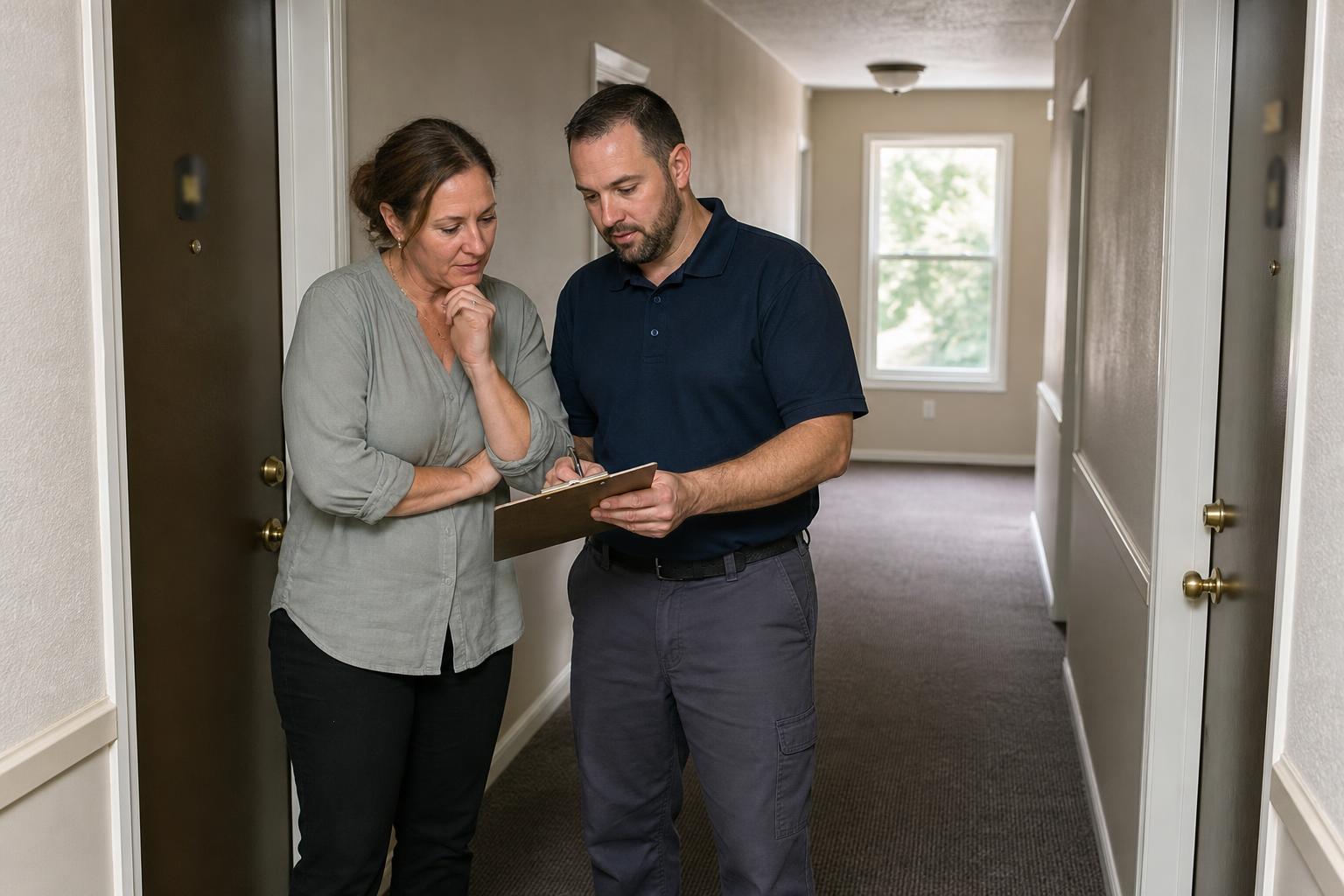
Bed bugs in an apartment building are not a bigger version of bed bugs in a house. They are a different job. The bugs move between units, tenants need to be scheduled and prepped one by one, and you need something on file when it is over. Our apartment bed bug treatment in Evansville is built for property managers: the owner inspects the reported unit and its neighbors, we coordinate with your tenants directly, we run 24 hours of heat at 135°F per unit, and an independent K9 team confirms the result.
- ScopeReported unit plus adjoining units
- Heat24 hours at 135°F, per unit
- TenantsWe call and schedule them ourselves
- Verified byK9 Detections (independent)
Why one unit at a time is how you pay three times
Here is the pattern we see in Evansville rentals. A tenant in 2B reports bed bugs. A company sprays 2B. Three weeks later, 2A reports them. A month after that, 2B calls again, angrier, and you have paid for three visits that never solved anything.
That is not bad luck. Bed bugs travel through wall voids, along plumbing and electrical runs, under shared doors and down hallways on laundry and furniture. By the time one tenant notices bites, the unit next door, above or below often has a small population nobody has reported yet. Treat only the unit that complained and you leave the source untouched, and to your tenant every reinfestation looks like the treatment failed.
You also carry a problem homeowners do not: you are not the one living there. You cannot see the mattress or do the prep, and you are relaying instructions through a tenant who may be embarrassed or hard to reach. A vendor who hands you a prep list and says “have them ready by Tuesday” has handed you the hardest part of the job.
Our multi-unit bed bug protocol
Apartments, single-family rental portfolios, small hotels and offices across Evansville and Southwest Indiana. The steps are the same every time.
Owner-led inspection of the reported unit and the units around it
Richard, our owner (Indiana 7A and 7B licensed), or our operations manager inspects the unit that complained and every unit sharing a wall, ceiling or floor with it: mattress seams, box springs, headboards, baseboards, outlets, furniture joints. You learn which units have activity and which are clear.
Written findings for the manager
What we found, unit by unit, in plain language, dated. Use it to set scope, brief ownership and answer the tenant who asks what we found.
Tenant prep coordination
We call your tenants directly, set the date, walk them through the short prep list (heat-sensitive items out, walls and furniture reachable) and answer their questions. You are copied on the plan, not stuck in the middle of it.
24 hours of heat at 135°F per unit, targeted treatment where indicated
Each unit with activity gets the full 24-hour heat treatment at 135°F, with fans pushing heat into voids and furniture. Where the inspection calls for it, we add targeted treatment at shared walls and entry points so the bugs have nowhere to retreat.
Independent K9 verification
K9 Detections, a separate company that does not work for us, sends a handler and a trained scent-detection dog through the treated units. If the dog clears them, the answer did not come from the people you paid. K9-verified
Documentation you can keep on file
A dated record of the inspection, the treatment and the verification result for each unit, ready for the next time a tenant, an owner or a prospective renter asks.
Tenant communication is part of the service
Most of the friction in an apartment bed bug job is not the bugs. It is the phone calls: the tenant who does not understand why the neighbor’s unit is being inspected, the one who is scared to say anything, the one who cannot take a day off. We take those calls. Richard and Gil handle scheduling and prep directly with the people who live there, in plain terms, so nobody feels blamed or left in the dark.
Great price. I’m a property manager for an apartment building and some single-family homes. Richard and Gil go above and beyond for us. They communicate and educate us well on any issues. They also communicate with tenants when needing to make appointments. Highly recommend.
What we give you when it is done
Three plain things, per unit:
- Dated findings. What the inspection turned up in the reported unit and each adjoining unit, and what it did not.
- A treatment summary. Which units were heat-treated, on what date, and where targeted treatment was applied.
- The verification result. Whether the independent K9 team cleared each unit, and the date they walked it.
Keep it in the unit file, so the next question gets answered with dates instead of memory.
Single-family home versus multi-unit building
If you manage both, here is how the job changes when the building has shared walls.
| Single-family home | Multi-unit building | |
|---|---|---|
| Inspection scope | The whole house | The reported unit plus every unit sharing a wall, floor or ceiling |
| Prep | One household, one list | Each affected tenant prepped separately; we handle the calls |
| Scheduling | One 24-hour window | Staggered 24-hour windows per unit, sequenced so treated units are not reinfested |
| Verification | K9 Detections walks the home | K9 Detections walks each treated unit; results recorded per unit |
| Documentation | Findings and result for the homeowner | Findings, treatment summary and result per unit, for the manager’s file |
If you rent, start with the guide
This page is written for the people who manage buildings. If you are a tenant who just found bed bugs, read I think I moved into an apartment that already had bed bugs first. It covers what to document, how to tell your landlord, and what not to do. Who pays for treatment in a rental depends on your lease and on current Indiana law; we are pest control, not lawyers, so check both. What we can do is inspect, treat and verify for whoever hires us.
Got a tenant complaint? Let the owner look before it spreads.
Richard or our operations manager inspects the unit and its neighbors, tells you what is there and puts a plan in writing. Free, no pressure.
Beyond bed bugs: keeping the building quiet
Bed bugs are the emergency. Roaches are the other pest that moves unit to unit through shared plumbing and wall voids. Many property managers put the building on a recurring schedule afterward so the next call is routine instead of a crisis.
Commercial and property management pest control
Recurring service for apartments, rental portfolios and small businesses, with tenant communication built in.
Cockroach control
The other pest that travels unit to unit. How we treat a building, not just a kitchen.
Bed bug control in Evansville
The full picture: 24-hour heat, independent K9 verification, and how you will know it worked.
Questions property managers ask us
Do you really need to inspect the units next to the one that complained?
Yes. The unit that reported them is often not the unit where they started. Inspecting the neighbors is how we find the source and how you avoid paying for the same unit again in a month. If a neighboring unit is clear, we tell you that, and it is not treated.
How do you handle tenants who will not cooperate or cannot be reached?
We call them ourselves, more than once if needed, and explain the prep so it feels manageable. If we still cannot reach someone, we tell you right away so you can use whatever notice process your lease and current Indiana law provide. We do not enter a unit without the access you have arranged.
Does the tenant have to move out for the 24-hour heat treatment?
People and pets have to be out for the treatment window, since the unit is held at 135°F. Most tenants stay with family or friends for the day and night. We schedule the window with them directly and tell them exactly when they can come back.
Can you treat one unit if the owner only approves one?
We can, and sometimes one unit is genuinely all there is. But if the neighbors have activity and go untreated, we say so in writing, because a treated unit next to an untreated one is likely to be reinfested. You get an honest scope; what to approve is your call.
What happens if the K9 alerts in a unit after treatment?
We go back in and deal with it, and the record shows that we did. That is the point of a dog that does not work for us: an alert is information, not an argument.
Do you work with small hotels and offices, not just apartments?
Yes. Guest rooms, break rooms and shared spaces get the same protocol: inspect the reported area and what adjoins it, 24-hour heat, K9 verification, dated documentation. For ongoing coverage, see commercial pest control.